Picture this. You hire an SEO agency, pay them every month, and six months later nothing has changed. Your traffic is still flat. Your phone is not ringing.
Sound familiar?
At SEOWebster, we audit websites every month, and the number one reason we see businesses waste money is simple: they hired the wrong kind of expert for their specific problem.
Here is something we have learned from doing this work. Many agencies are great at writing content and finding keywords. But if your website is broken underneath, they cannot fix it. Other agencies are full of brilliant coders. They can make your site load faster than lightning. But they do not understand what your customers are actually searching for.
They sell you half a solution. And half a solution gives you zero results.
We have been on both sides. We have helped startups find their first real customers through smart keyword research, and we have written code that pulled eCommerce sites back out of indexing problems that were making them disappear from Google. We have seen the exact moment things turn around, when strategy and technical work finally come together.
So which expert does your business actually need? The answer depends on where your website hurts.
This is not a theory. It is a practical guide based on real problems we have fixed for clients. By the end, you will know exactly who to hire, and whether your current agency can actually solve your problem.
Why does this matter for your bottom line? Because every month you pay for the wrong expertise is a month your competitors pull further ahead in search, and that gap compounds into lost leads and revenue.
Hire an SEO Specialist when your site is technically healthy but not ranking, and an SEO Engineer when your site is broken, slow, or too complex for off-the-shelf tools. Most growing businesses eventually need both: the Specialist finds the opportunities, the Engineer builds them.
What Does an SEO Specialist Do?
Let us start with the most common role you will see out there.
An SEO Specialist is your strategist. They figure out what your customers are searching for, what your competitors are doing, and what content you need to create to win. Think of them as the architect. They draw the blueprints. They do not build the house, but they make sure everyone knows exactly what needs to be built.
First, they dig into keyword research. They find the exact phrases your potential customers are typing into Google. Not the obvious ones everyone else is targeting, but the smart ones, the questions people are actually asking.
Second, they study your competitors. They look at who is ranking above you and figure out why. Better content? More links? A cleaner site structure? They take that intelligence and build a plan to beat them.
Third, they optimize your content. They make sure each page is built around one clear topic. They write title tags and meta descriptions that make people want to click. (A quick way to test yours is our free meta title and description checker, which previews the exact Google snippet before you publish.) They structure your internal links so Google can easily find and understand your most important pages.
They also run audits. They spot the low-hanging fruit, broken pages, missing meta tags, slow-loading images, and flag these issues so the technical team can fix them.
But here is the catch. An SEO Specialist can tell you what is broken, but they cannot always fix the deep stuff. If your site is built on a messy platform, if your code is spaghetti, or if Google simply cannot crawl your pages properly, the Specialist is stuck. They can recommend. They cannot execute.
That is where the Engineer comes in.
When should you hire an SEO Specialist? If your site is technically healthy but you are not ranking well, you need a Specialist. If your content is thin, your keyword strategy is outdated, or you are losing to competitors who understand their audience better, a Specialist is your answer. This is the same strategy-first thinking behind the difference between an SEO strategist and an SEO manager: the value is in mapping the path to growth before anyone touches the build.
What Does an SEO Engineer Do?
Now let us talk about the other side of the coin.
An SEO Engineer is your builder. They take the blueprints from the Specialist and actually make them work. They write code, fix broken systems, and automate the boring stuff so the whole operation runs smoothly. Think of them as the construction crew. While the Specialist draws the plans, the Engineer picks up the tools and builds the house.
First, they fix crawling and indexing problems. Google has to be able to find and understand your pages. If your site is built with JavaScript, if you have duplicate content everywhere, or if your sitemap is a mess, the Engineer digs in and cleans it up.
Second, they make your site faster. Core Web Vitals matter. A slow site loses visitors and rankings. The Engineer knows how to optimize images, clean up code, and set up caching so your pages load in the blink of an eye.
Third, they handle structured data, the behind-the-scenes code that helps Google understand your content. When you see rich results in search, like star ratings or FAQs, that is the Engineer’s work.
Fourth, they build automation. Instead of manually checking 10,000 pages for errors, they write scripts that do it for them. They pull data from Google’s APIs, build custom dashboards, and create tools that make the marketing team more efficient.
Fifth, they work with developers. Most agencies struggle because they do not speak the same language as the client’s dev team. The SEO Engineer bridges that gap. They know how to communicate technical requirements without causing friction.
But here is the catch. An SEO Engineer can fix technical disasters, but they often do not own the strategy. They can make your site fast and flawless, but they will not always know which keywords to target or what content your audience wants. That is why the Specialist and the Engineer need each other.
When should you hire an SEO Engineer? If your site is huge, if it is built on a complex platform, or if Google is not indexing your pages properly, you need an Engineer. If your site takes forever to load, if you are migrating to a new domain, or if your developers keep breaking your SEO without realizing it, an Engineer is essential. This is the discipline we cover in our technical SEO services.
Quick Comparison
Still confused? Here is a quick side-by-side look at the two roles.
The simple version: the Specialist figures out what needs to be done, the Engineer figures out how to do it. Both are essential. A good agency gives you access to both.

Before hiring anyone, ask the agency directly: who on our team handles strategy, and who handles technical execution? If it is the same person on a complex site, treat it as a warning sign.
Key Differences
Let us move beyond the surface. Here is what actually sets these two roles apart in the real world.
Technical knowledge. The Specialist knows SEO inside and out: how search engines work, what ranking factors matter, how to optimize content. But their technical knowledge stops at a certain point. They can run an audit, spot broken links, and identify duplicate titles. Ask them to rewrite a robots.txt file or debug a JavaScript rendering issue, and they will likely be lost. The Engineer lives in that world. They understand how servers talk to browsers, how Googlebot crawls and renders pages, how to read log files and debug schema markup. They do not just know what is broken. They know why, and how to fix it.
Day-to-day work. The Specialist spends their time in tools like Ahrefs, Semrush, and Google Search Console, analyzing competitors, mapping keywords to customer journeys, and briefing writers. The Engineer spends their time in code, writing Python scripts, pulling data from APIs, and optimizing server responses. Their day is terminal commands, commits, and performance tests.
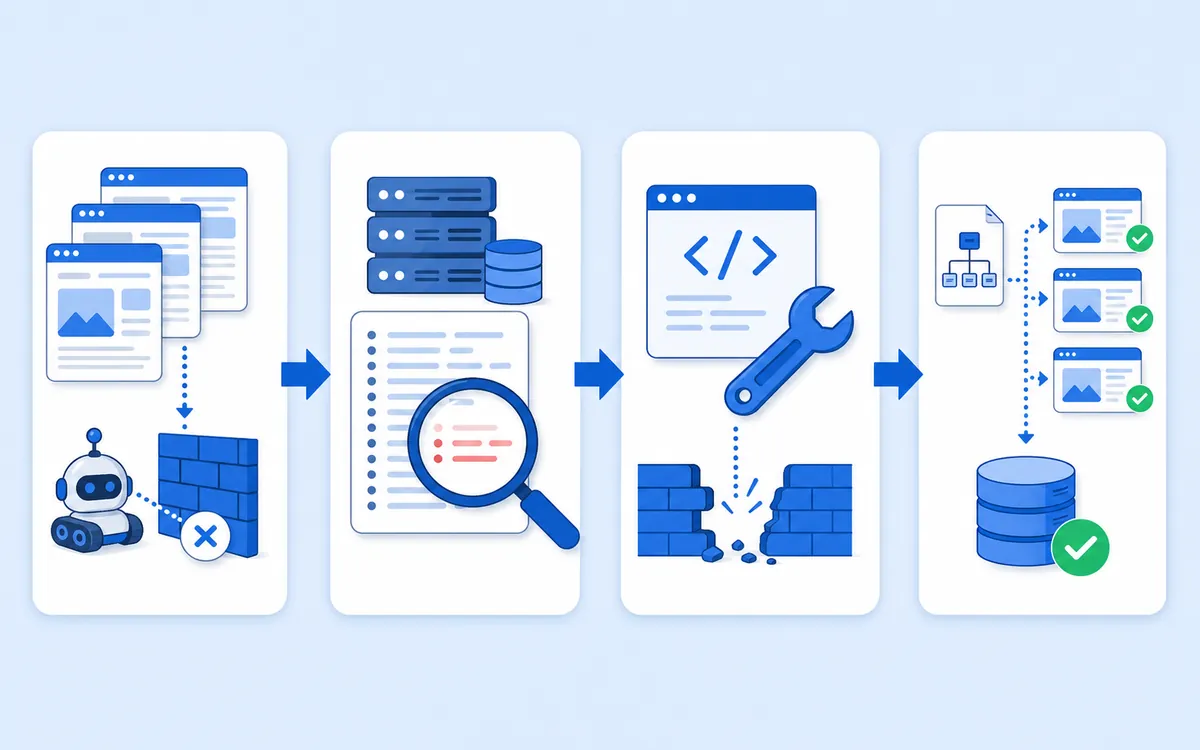
How they solve problems. The clearest way to see the difference is a real scenario. Say you discover that half your pages are not indexed by Google.
Runs a report, identifies the affected pages, and recommends a fix: "clean up your sitemap and fix your internal linking." Solid advice, but that is as far as they can go. They found the problem.
Digs into the server logs, sees how Googlebot is crawling, finds the JavaScript blocking the crawler, rewrites the code, deploys the fix, and verifies the pages are indexed. They fixed the problem.
Website size and complexity. The Specialist can handle almost any site size; the approach is similar whether you have 100 pages or 100,000. The Engineer becomes essential when your site gets huge or complex. Enterprise sites, large eCommerce stores, SaaS platforms, and marketplaces all need engineers. If you have millions of URLs or a custom-built platform, the Engineer is non-negotiable.
Skills for Each Role
SEO Specialist skills
The foundation. Finding the exact phrases your customers type into Google, the long-tail questions that convert, and studying what competitors rank for.
Writing for humans and search engines at once: title tags that get clicks, meta descriptions that drive traffic, content structured so it is easy to read and easy for Google to understand.
Proper heading tags, optimized images, and internal linking that makes sense. You do not need to be a developer, but you need to know what good looks like.
Comfort with Google Search Console, Google Analytics, and tools like Ahrefs. Spotting trends, identifying problems, and proving results with hard numbers.
Explaining complex SEO concepts to clients, writers, and designers who do not speak SEO, and writing clear briefs.
SEO Engineer skills
Understanding crawling, indexing, rendering, and ranking, and how Googlebot behaves.
Python is the most common language for SEO automation. JavaScript is critical for modern frameworks like React or Vue. You need to be comfortable writing scripts.
Querying databases, pulling reports, and analyzing large data sets.
Pulling data from Google's Search Console, Analytics, and PageSpeed Insights APIs and turning it into something useful.
Log files tell you exactly how Googlebot crawls your site. Reading and acting on them.
URL structure, internal linking, site speed, and mobile optimization, and spotting structural issues most people miss.
Writing scripts instead of checking pages by hand, and using Git to track changes and deploy fixes without breaking things.
If you are building this capability in-house, our guide to structuring and scaling an SEO team covers how these roles fit together as you grow.

Salary and Demand
Which role costs more to hire, and which is harder to find?
Salary. SEO Engineers generally earn more, because coding skills are harder to find. That does not make Specialists cheap; a senior Specialist with a track record commands a high salary. But at entry and mid level, Engineers typically earn 15% to 25% more. Exact numbers depend on location: in the US, a mid-level Specialist might earn $70,000 to $90,000, a mid-level Engineer $90,000 to $120,000. In the UK, Europe, or Australia the numbers shift but the ratio holds.
Demand. Both roles are in high demand, but differently. Specialists are needed everywhere; if you have a website, you need someone to optimize it, so the role is more common and easier to find. Engineers are more specialized, especially valuable for enterprise sites with millions of pages, complex eCommerce catalogs, JavaScript-heavy SaaS platforms, and programmatic SEO at scale. If your site is simple, you probably do not need a full-time Engineer. If it is complex, you cannot survive without one.
The practical takeaway: if you are hiring an agency, ask who is on your team. Do they have a Specialist who understands your audience and competitors? Do they have an Engineer who can fix technical problems and automate the work? If they only have one, you are getting half a solution.
Which Role Is Right for You?
This is the question you came here to answer. Neither role is better than the other. They are different, and the right choice depends entirely on where your website hurts.
Choose a Specialist
Your site is technically healthy but not ranking. Content is thin, the keyword strategy is weak, or competitors simply understand the audience better. Your foundation is solid; your strategy is not.
Choose an Engineer
Your site is large or on a custom platform, Google is not indexing your pages, the site is slow, you are migrating domains, or developers keep breaking your SEO. It is too complex for off-the-shelf tools.
Choose both
You have technical problems and strategic gaps, want to scale aggressively, or run an enterprise, eCommerce, or SaaS site. Most businesses land here: start with one, add the other as you grow.

When you work with an agency that has both, you do not have to choose, hire two separate companies, or manage multiple relationships. You tell them your goals and they handle strategy and execution together.
From Specialist to Engineer
Can an SEO Specialist become an SEO Engineer? Yes, but it takes work.
The good news is that Specialists already understand the fundamentals: how search engines work, keywords, content, and user intent. That is a huge head start over someone from a pure coding background. The bad news is that learning to code is hard. You cannot become an Engineer overnight, but with effort the transition is absolutely possible.
A practical roadmap:
- Strengthen your technical SEO knowledge first: crawling, indexing, rendering, and ranking. If you do not understand how Googlebot works, you cannot build systems to optimize it.
- Learn HTML, CSS, and JavaScript fundamentals. You do not need to be a full-stack developer, but you need to understand how sites are built, which is essential for debugging JavaScript SEO issues.
- Learn Python for SEO automation. Start small: pull data from the Search Console API, automate your reporting, build a script to check for broken links.
- Study APIs, SQL, and log file analysis. These are the tools of the trade and give you a direct view of how Googlebot crawls your site.
- Build small SEO tools and scripts. A duplicate-title checker, a rank monitor, a dashboard that pulls from multiple sources. These teach you more than any course.
- Learn Git and development workflows. Track your changes, collaborate with engineering teams, and understand deployment.
The biggest barrier is not technical, it is mindset. Many Specialists are intimidated by code and never try. The ones who succeed start small, fail often, and keep learning. Some of the strongest technical SEOs began as Specialists and added engineering skills on top, bringing their strategic thinking with them.
Can One Person Do Both?
It depends.
In small companies and startups, one person often does both: strategy, content, technical fixes, and whatever automation they can manage. They are the entire SEO department, and it works. It just takes longer.
But as your business grows, that model breaks down. If you have thousands of pages, complex JavaScript, or a custom platform, one person cannot do it all. The Specialist work alone can fill a week; the Engineer work fills another. More importantly, the skill sets differ. A great Specialist might not enjoy coding; a great Engineer might not enjoy keyword research. Forcing one person to do both usually leads to burnout and mediocre results.
There is a middle ground: the Technical SEO Specialist. Not a full Engineer, but able to write basic scripts, debug simple JavaScript, and speak the developers’ language. This hybrid role is valuable, and for many small businesses it is the right first hire. But it is not a replacement for a full Engineer on complex projects. If you are serious about scaling, you need both.
Frequently Asked Questions
Is an SEO Engineer a software engineer?
Not exactly, but the role requires programming knowledge. They write code, work with APIs, and understand website architecture. They are not building full applications, but they are comfortable with code and use it to solve SEO problems.
Does an SEO Specialist need coding skills?
No, but it helps. You can do excellent keyword research, content optimization, and strategy without writing a line of code. But basic HTML, CSS, and JavaScript knowledge helps you spot technical issues and communicate with developers.
Is technical SEO the same as SEO engineering?
No. Technical SEO (site speed, crawling, indexing, structured data) is a part of SEO engineering. Engineering also includes automation, custom tool building, API integration, and working with large data sets. It is technical SEO taken to the next level.
Can a developer become an SEO Engineer?
Yes. Developers make excellent SEO Engineers. They already understand code, servers, and architecture; they just need to learn how search engines crawl, index, and rank.
Which role is more senior?
It depends on the company. Sometimes the Engineer is more senior because of the advanced technical skills; sometimes the Specialist leads because they drive strategy. They are different career tracks, not a hierarchy.
Which role should I hire first?
Start with a Specialist if your site is technically healthy. Start with an Engineer if your site is broken or too complex. If you are not sure, a proper audit will tell you which one your site needs.
The Bottom Line
Neither role is better than the other. SEO is not just about content, and it is not just about code. It is about both, and the best results come when strategy and execution work together.
If your site is technically healthy but you are not ranking, you need a Specialist to find the opportunities and build the strategy. If your site is broken, slow, or not being indexed, you need an Engineer to fix the foundation so it can rank. If it has both problems, and most businesses do, you need both.
If you run an agency, the same logic applies to your team. You cannot deliver great results with just strategy or just technical work. Do not settle for an agency that offers half the solution, because if they only do strategy your technical problems will hold you back, and if they only do technical work your content will never reach its potential.
If you are still not sure which expert you need, start with a free AI SEO audit. It diagnoses what is actually broken on your site and points you toward the right fix, whether that is strategy, technical work, or both.
Have questions about this article?
Ask the AI assistant anything — it has context on everything you just read.
AI Assistant
Ask about this article
I can summarize this article, explain concepts, and suggest related posts on SEOwebster.com.
Try asking