A potential customer opens ChatGPT, Gemini, Claude, or Perplexity and asks a simple question: “Who is the best [service] provider in [city]?”
Your competitors appear. Your business does not.
That does not automatically mean your website has bad SEO. Traditional search visibility and AI visibility overlap, but they are not the same thing. A business can rank on page one of Google and still be invisible when a customer asks an AI assistant for a recommendation.
The reason comes down to what AI systems actually use to build an answer: search indexes, website content, third-party sites, directories, reviews, brand mentions, structured data, entity relationships, publications, real-time retrieval, and knowledge baked into the model itself.
Which raises the question at the center of everything on this page:
What signals are missing when AI systems fail to mention, cite, or recommend your business?
TL;DR: AI assistants recommend businesses they can confidently identify, retrieve, and corroborate. If you are missing, it is usually because the AI cannot clearly identify your entity, has too few independent mentions of your brand, cannot connect you to the topic, or has found stronger evidence for a competitor. The fix is not a hidden trick. It is making your business understandable, relevant, authoritative, corroborated, and accessible.
The shift is real and measurable. In 2024, Gartner predicted that traditional search engine volume will drop 25% by 2026, with search marketing losing share to AI chatbots and virtual agents. A customer who asks an AI assistant for a recommendation is not going to scan ten blue links. The businesses that show up in that single answer win the moment.
What AI Visibility Means
“Appearing in AI” is not one thing. The same business can be visible in several different ways, and confusing them leads to the wrong strategy.
Brand mention is when the AI names your business, even in passing. Business recommendation is when the AI actively suggests your company in response to a commercial question. Website citation is when your site appears as a cited source. Product or service mention is when your specific offering is named even if the brand receives less emphasis. Local recommendation is when you appear for a location-based prompt, like “Who are the best solar installers in Melbourne?” And informational citation is when your content is used as evidence for an informational answer rather than a commercial recommendation.
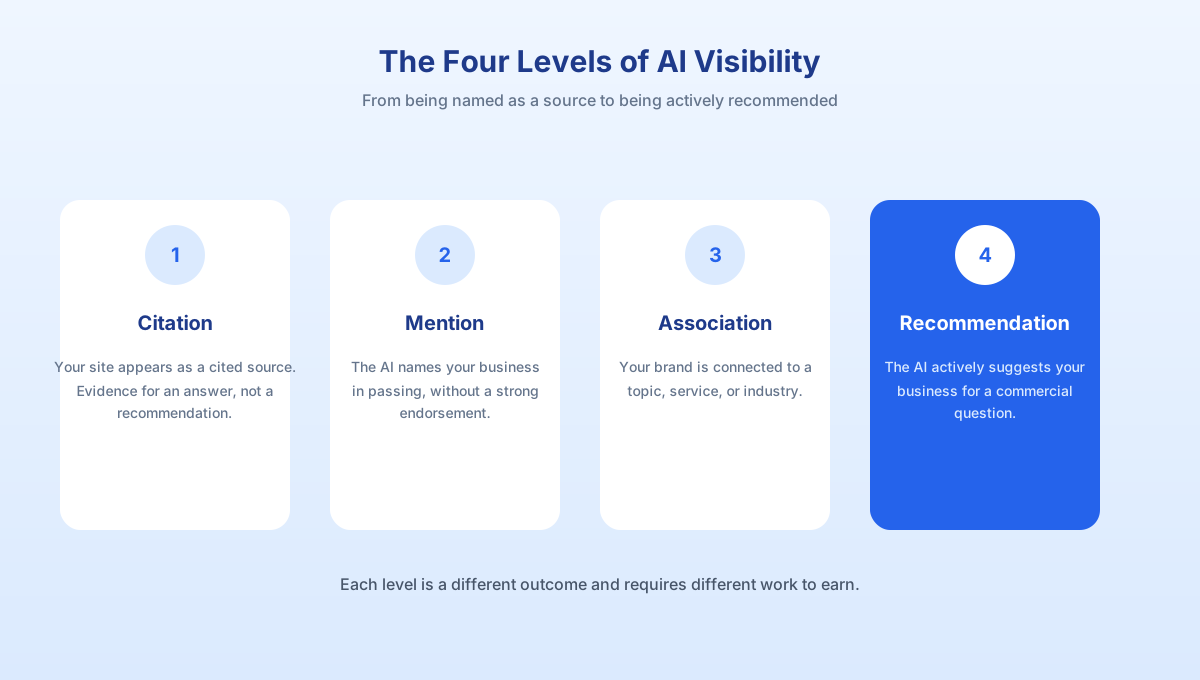
Treating all of these as the same goal is the fastest way to waste effort. Being cited in an informational answer and being recommended for a commercial purchase are different problems with different solutions.
How AI Tools Find Businesses
AI systems do not all work the same way, but they draw from a shared ecosystem of signals. Understanding that ecosystem is the difference between guessing and diagnosing.
Search engine retrieval. Some AI systems pull current web results in real time when answering questions. If you are not discoverable to the search and retrieval systems underneath, you are harder to surface.
Model knowledge. Some information about your brand may already live in a model’s trained knowledge. If you are new, or your web presence is thin, that knowledge may simply not exist yet.
Third-party sources. AI systems discover businesses through directories, review sites, publications, comparison pages, news sites, industry websites, associations, forums, and expert articles. These are independent signals, and they carry weight precisely because they are not controlled by you.
Your own website. This remains your most important first-party source. It is where you define who you are, what you offer, who you serve, where you operate, and what makes you different.
Entity relationships. AI systems need enough context to connect the dots confidently.
Entity relationship chain
When this chain is complete and consistent, an AI system can place your business correctly. When links are missing or conflicting, it cannot.
Why Your Business Is Missing
This is the diagnostic heart of the article. If you are not showing up, one or more of these signals is weak. Work through them honestly and you will usually find the gap.
AI cannot identify your entity
Entity clarity is the foundation. If different places describe your business differently, the AI has nothing stable to anchor to.
Compare these two descriptions. One is generic and tells a machine almost nothing:
“Helping businesses grow online.”
The other creates a clear, useful entity:
“[Company] is an Australian digital marketing agency providing SEO, paid search and web development services for SaaS and ecommerce companies.”
The second tells an AI system who you are, what you do, where you operate, and who you serve. The first tells it nothing it can act on.
Your brand lacks web mentions
Your website telling AI what you do is only one signal, and it is the least independent one. Other websites confirming the same information is stronger evidence.
Relevant directories, business profiles, industry publications, interviews, podcasts, associations, expert roundups, partner websites, and editorial mentions all reinforce who you are. This is the difference between self-declared authority and externally validated authority. The first is easy to fake. The second is what AI systems tend to trust.
Your topics are too shallow
A single service page is rarely enough. AI systems build answers by drawing from specific, fragmented questions, so your site needs to cover the topic deeply enough to be a candidate source for many of them.
A topical structure for an SEO agency might look like this:
- Technical SEO
- Local SEO
- SaaS SEO
- Ecommerce SEO
- SEO audits
- Keyword research
- Link building
- AI search optimization
- Supporting educational content
Each of these is a place where a question could be asked, and where your business either is or is not a candidate to be cited.
You do not answer AI queries
Traditional keyword targeting misses conversational search. People do not type “SEO agency Melbourne” into an assistant. They ask:
- What SEO agency should a SaaS startup hire?
- Which Melbourne SEO agencies specialize in technical SEO?
- Who provides SEO for ecommerce businesses?
- Which SEO companies have experience with SaaS?
These are questions, scenarios, comparisons, and recommendation prompts. If your content only targets short keywords and never answers these, you are invisible to the queries that actually drive AI recommendations.
Your brand-topic link is weak
This is one of the most important GEO concepts in this article. AI systems need evidence that connects your brand to a topic, a service, a location, an industry, or a customer type.
You may want to be known for “SaaS SEO agency.” But if the websites that matter rarely associate your company with SaaS SEO, the relationship stays weak.
Weak association
Strong association
You have little original evidence
Generic content is easy to reproduce, so it is easy for an AI to find ten sources saying the same thing. Visibility favors information that originates with you.
Original research, surveys, internal data, benchmarks, case studies, experiments, expert commentary, first-party statistics, proprietary frameworks, and industry observations all make your site the place AI goes for something it cannot get elsewhere.
The distinction is simple: you can either repeat existing information, or you can become the source of information. The second is what gets cited.
Your business data conflicts
This matters especially for local businesses. If your name, address, phone, website, service categories, opening hours, locations, brand description, and social profiles are not consistent everywhere they appear, the conflicting signals create uncertainty.
A machine asked to recommend a business will not untangle two different phone numbers or three variations of your name. It will skip you and recommend someone whose data is clean.
Your site blocks discovery
Technical barriers stop both search engines and AI crawlers from reaching your content. Check for robots.txt restrictions, noindex directives, incorrect canonicals, broken pages, JavaScript rendering issues, poor internal linking, orphan pages, inaccessible content, and slow or unreliable pages.
Your content lacks structure
Machines read structure. Logical H1 to H3 hierarchy, descriptive headings, short explanatory paragraphs, lists, comparison tables, definitions, FAQs, clear service descriptions, and consistent terminology all make your content easier to parse and reuse.
Your schema is incomplete
Structured data such as Organization, LocalBusiness, Service, Product, Person, Article, and BreadcrumbList helps machines understand what your pages contain.
Trust signals are weak
Real company information, an About page, author pages, expert bios, credentials, case studies, customer testimonials, reviews, editorial policies, contact information, and evidence supporting your claims all signal that a real, trustworthy business stands behind the content.
This connects naturally to E-E-A-T (experience, expertise, authoritativeness, and trustworthiness), but it is worth being precise: E-E-A-T is a concept for evaluating content quality, not a direct, measurable AI ranking factor. Strong trust signals still matter because they make you the kind of source worth citing.
Mentions lack context
Three different signals are easy to confuse:
- Backlink — a site links to your business.
- Brand mention — a site names your business.
- Contextual association — a site discusses your business in connection with a specific topic, service, or expertise.
A contextual mention like “[Brand] provides technical SEO” creates a clearer topical relationship than an unrelated company-name mention. Volume helps, but relevance and context matter more.
Competitors have more proof
AI visibility is often relative. The question is not only “Is my website optimized?” It is also “Does the web provide stronger evidence for my competitor?”
| Signal | Your Business | Competitor |
|---|---|---|
| Relevant content | Medium | Strong |
| Service coverage | Limited | Extensive |
| Authoritative mentions | Few | Many |
| Reviews | Few | Many |
| Industry listings | Few | Strong |
| Case studies | 1 | 10+ |
| Expert citations | Low | High |
| Brand-topic associations | Weak | Strong |
| Original research | None | Regular |
| Local signals | Partial | Consistent |
If a competitor wins on most of these, the AI is simply following the evidence. Closing that gap is the real work.
Platform Differences
There is no single universal “AI ranking.” Each platform retrieves and represents information differently, so a strategy built around one platform will miss the others.
ChatGPT combines model knowledge, web retrieval where available, search results, citations, and brand or entity information, all shaped by the query context.
Google Gemini sits within Google’s broader search ecosystem. Being legible to Google’s entity and retrieval systems tends to matter, but a normal Google ranking does not directly determine what Gemini recommends.
Perplexity is built around citations. It shows its sources, which means being present on high-quality, retrievable, citable sources is the core requirement.
Claude behaves differently from the others, and its web and search capabilities are not identical to ChatGPT, Gemini, or Perplexity. Do not assume every Claude experience retrieves information the same way.
Google AI results, including AI Overviews and AI Mode, sit on top of Google’s search index. They are generative search experiences, not standalone chatbot recommendations, and the mechanics are different.
There are also other emerging assistants, and user behavior keeps shifting. Build a foundation that works across all of them rather than optimizing for one.
| Platform | Mention | Citation | Recommendation | Live Retrieval |
|---|---|---|---|---|
| ChatGPT | Varies | Varies | Varies | Where available |
| Gemini | Varies | Varies | Varies | Varies |
| Perplexity | Common | Core | Varies | Yes |
| Claude | Varies | Varies | Varies | Differs |
| Google AI Overviews | Common | Common | Varies | Yes (index) |
Treat the specifics in this section as a snapshot. Verify current behavior against official documentation before publishing, because these products change quickly.
SEO, AEO and GEO
These three disciplines overlap, and it helps to keep them distinct.
SEO improves visibility within traditional search engines.
AEO, or Answer Engine Optimization, optimizes content for direct answers and answer-oriented experiences.
GEO, or Generative Engine Optimization, improves the likelihood that generative systems understand, retrieve, cite, or discuss a brand and its information.
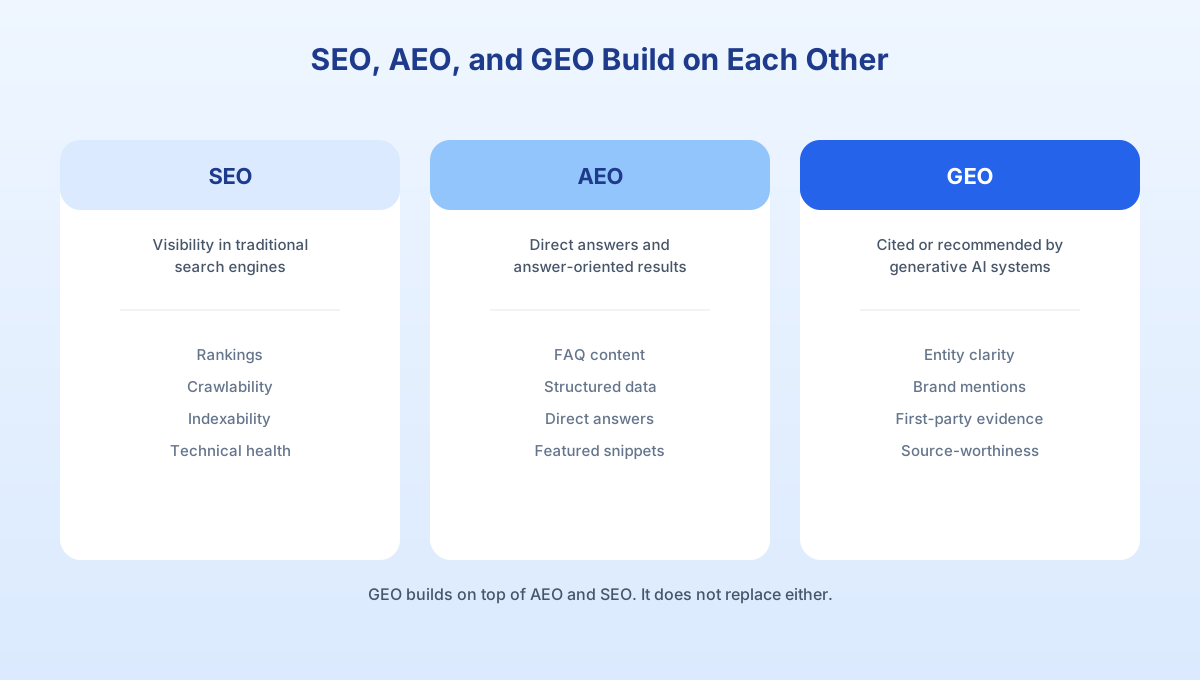
GEO is not a replacement for SEO. It builds on top of it. A site with broken crawlability and thin content cannot be rescued by GEO tactics alone.
How to Improve AI Visibility
The diagnosis turns into a framework. Work through these in order.
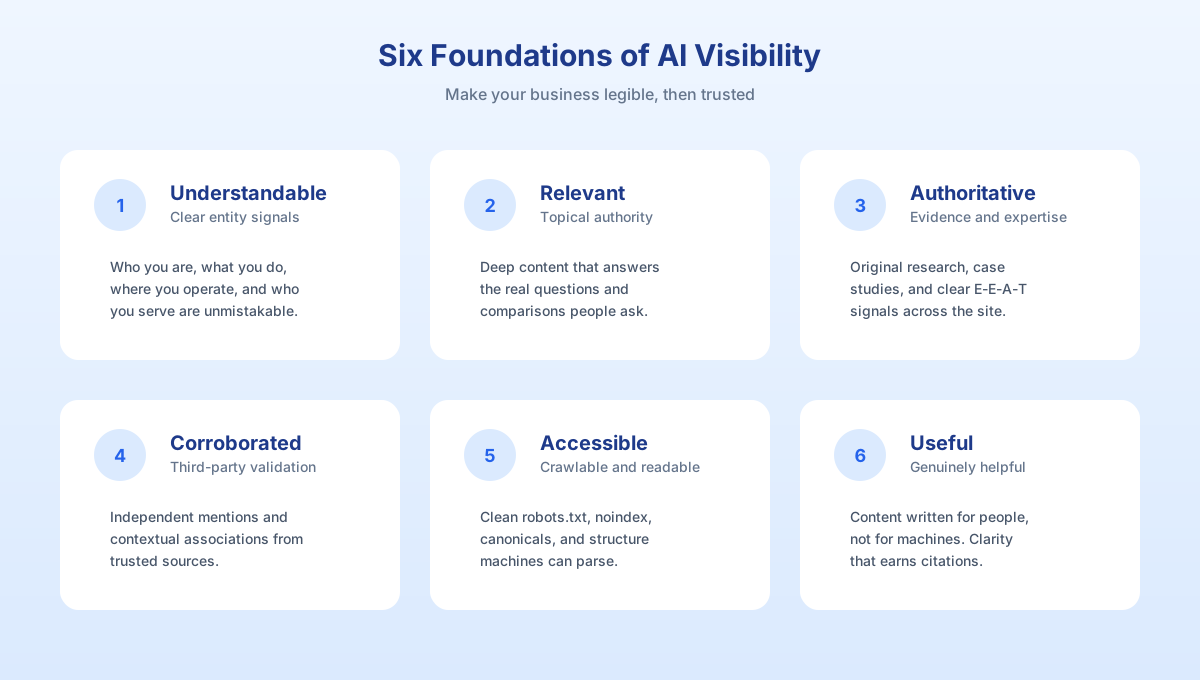
- Build entity clarity. Make it unmistakable who the company is, what it provides, where it operates, who it serves, what industries it specializes in, and what expertise it has.
- Build topical authority. Create service clusters and supporting educational content. Prioritize genuine depth over publishing hundreds of thin pages.
- Answer real questions. Build content around questions, problems, comparisons, alternatives, costs, recommendations, use cases, industries, locations, and buyer concerns.
- Publish unique evidence. Create case studies, surveys, research, benchmarks, experiments, data analysis, and expert commentary.
- Earn relevant mentions. Focus on relevance and context rather than collecting arbitrary links, through industry sites, publications, associations, directories, partners, interviews, podcasts, and research citations.
- Strengthen local entities. Optimize business profiles, maintain consistent details, build location-specific authority, earn local mentions, and collect genuine reviews.
- Improve site accessibility. Audit crawlability, indexability, internal links, rendering, canonicals, site architecture, page accessibility, and structured data.
- Improve content structure. Use clear headings, direct answers, definitions, lists, tables, comparisons, and supporting evidence.
How to Audit AI Visibility
You cannot fix what you cannot see. Turn this into a repeatable process.
Create target prompts
Test the prompts that matter, not just generic ones. Brand prompts (“What is [Brand]?”), recommendation prompts (“What are the best [service] companies in [location]?”), comparison prompts (“Compare [Brand] and [Competitor]”), and problem prompts (“Who can help with [specific problem]?”).
Test multiple platforms
Run comparable prompts across ChatGPT, Gemini, Perplexity, Claude, and Google’s generative results. One platform is not a benchmark.
Record the results
| Prompt | Mentioned | Recommended | Cited | Position | Competitors | Sources |
|---|---|---|---|---|---|---|
| ... |
Repeat important prompts over time and watch for movement.
Analyze cited sources
Look at which websites repeatedly influence results. Are they directories, publishers, review platforms, competitor sites, industry resources, forums, or research publications? This exposes the authority gaps you have not yet filled.
Compare competitors
For each competitor appearing more often than you, analyze their content depth, backlinks, brand mentions, directories, reviews, case studies, PR, research, topic coverage, and entity consistency. AI visibility analysis is a competitive-gap exercise, not just a self-check.
What Not to Do
A short list of traps that waste budget and create risk.
Do not stuff AI keywords. Writing “ChatGPT,” “AI search,” and “GEO” repeatedly does not create authority.
Do not create thin AI pages. Hundreds of nearly identical pages targeting every conceivable AI query will not help and can hurt.
Do not chase every crawler. Crawler accessibility is only one part of the ecosystem, not the whole game.
Do not fake reviews. Artificial trust signals can create wider reputation and platform problems.
Do not buy random mentions. Topical relevance and source quality matter more than raw volume.
Do not abandon SEO. AI-search optimization should build on strong SEO foundations, not replace them.
How Long Results Can Take
There is no universal timeframe, and anyone promising one is guessing. Movement depends on crawling, indexing, source discovery, content updates, brand authority, third-party coverage, AI retrieval systems, and model or search updates.
Can AI Visibility Be Guaranteed
No.
No company can guarantee that a particular AI system will recommend a specific business for a particular prompt. You can improve discoverability, entity clarity, topical relevance, authority, third-party corroboration, information accessibility, and source-worthiness, but the final generated response is controlled by the AI platform.
Saying this plainly is important. It separates credible work from sales pitches, and it sets the right expectation for everything else in this article.
AI Visibility Checklist
Run through this before you call your AI-visibility work done.
- My company has a clear entity description.
- Services are clearly defined.
- Industries and audiences are identified.
- Location information is consistent.
- My website is crawlable and indexable.
- Important pages are internally linked.
- My content answers real customer questions.
- My topic clusters demonstrate expertise.
- I publish original evidence or case studies.
- Relevant websites mention my brand.
- My brand is contextually associated with target topics.
- Business directories contain accurate information.
- Customer reviews are present where appropriate.
- Relevant structured data is implemented.
- Authors and company expertise are visible.
- I test AI visibility across multiple platforms.
- I record competitors appearing for target prompts.
- I analyze the sources AI systems cite.
Frequently Asked Questions
How do I get on ChatGPT? +−
Why does ChatGPT miss my business? +−
How do I rank in AI search? +−
Does SEO help AI visibility? +−
Do backlinks help AI search? +−
Does schema help AI search? +−
Can I submit to ChatGPT? +−
How do I appear in Gemini? +−
How do I rank in Perplexity? +−
What is AI visibility? +−
What is GEO? +−
Can AI rankings be guaranteed? +−
Key Takeaway
Getting mentioned by AI is not about finding a hidden ChatGPT ranking trick. AI visibility is built by making a business understandable, relevant, authoritative, corroborated, accessible, and useful.
A company has to establish not just that it exists, but who it is, what it does, what it knows, who trusts it, and why it deserves to be included.
If competitors keep appearing in AI recommendations while you do not, the gap is almost always one of those signals. Find it, close it, and the recommendations tend to follow.
Not sure why competitors appear in AI recommendations while your company does not?
An AI visibility audit identifies the missing entity, content, authority, and citation signals affecting your brand.
See our Generative Engine Optimization serviceHave questions about this article?
Ask the AI assistant anything — it has context on everything you just read.
AI Assistant
Ask about this article
I can summarize this article, explain concepts, and suggest related posts on SEOwebster.com.
Try asking