New Search Reality
Search behavior has shifted from result pages to synthesized AI answers. Privacy clarity now directly affects ranking resilience, answer extraction quality, and citation trust.
Search in 2026 is no longer a simple list of 10 blue links. Users increasingly get synthesized answers, summaries, and recommendations generated by AI systems before they click a source.
At the same time, the privacy paradox is growing:
- Users expect highly relevant experiences
- Users distrust unclear data collection
- Buyers reward brands that explain data practices in plain language
The core shift is clear. AI data privacy is not just a legal checkbox. It is now part of ranking resilience, answer selection, and generative citation trust.
- Privacy clarity improves user confidence and answer trust
- Structured trust signals improve extraction for AEO
- Entity consistency improves citation reliability for GEO
- Teams that align SEO and policy content reduce long-term rework
Teams that align privacy disclosures with search content tend to reduce user hesitation in high-intent journeys. Google's AI search direction and Pew's AI trust findings both point to the same pattern - people want useful AI answers with clear accountability.
Defining the Multi-Layered Optimization Framework
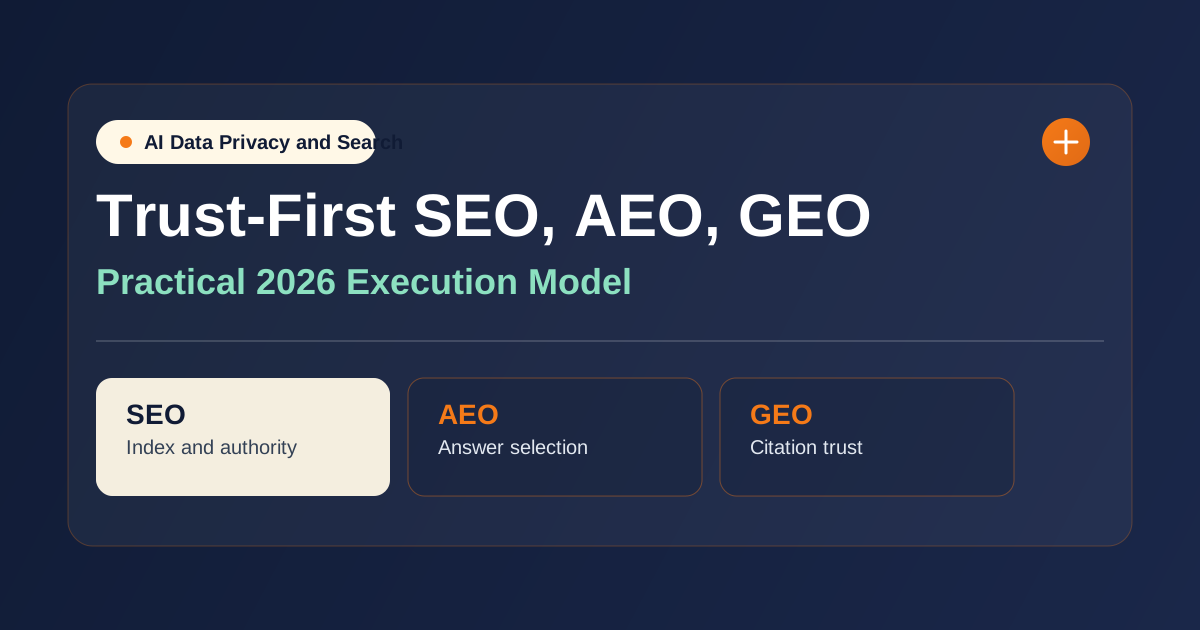
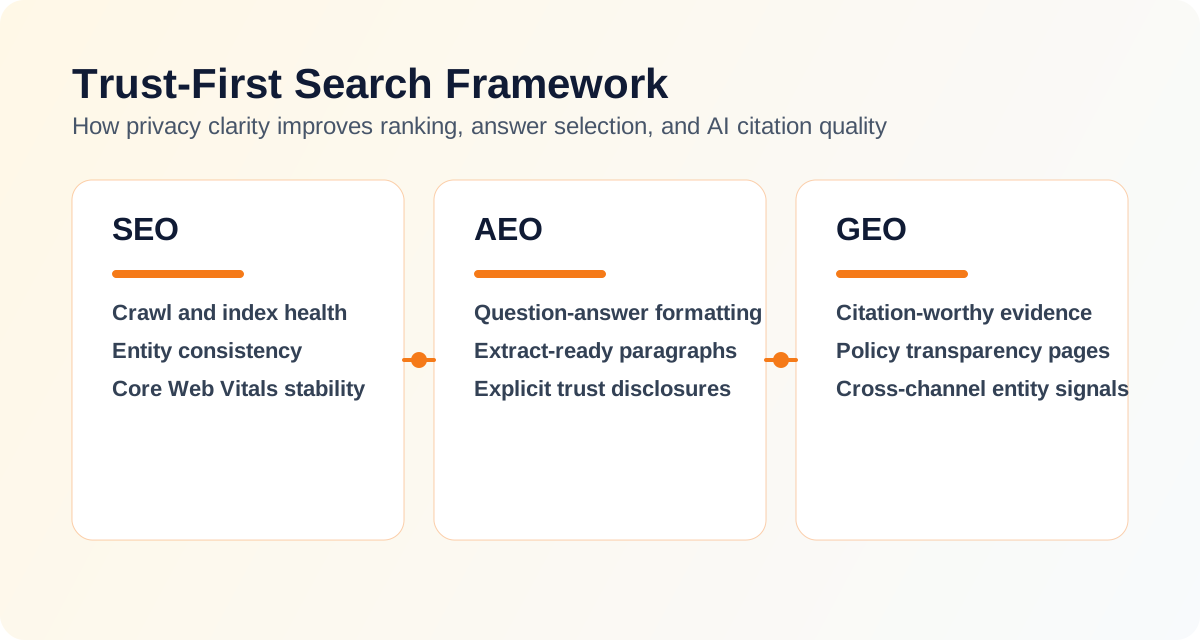
Use a three-layer execution model. SEO builds discoverability, AEO improves answer selection, and GEO increases citation probability across AI engines.
| Layer | Primary Goal | Execution Focus |
|---|---|---|
| SEO | Get indexed and ranked | Technical foundations, internal links, crawl health |
| AEO | Get selected as the answer | Question format, extract-ready paragraphs, policy clarity |
| GEO | Get cited during synthesis | Entity consistency, trust content, verifiable facts |
SEO Foundation
Prioritize crawl health, technical quality, and entity consistency so your pages are retrieval-ready.
AEO Selection
Use question-first sections and extract-ready summaries to improve direct answer selection.
GEO Citations
Support claims with source context and stable entities so AI systems can cite with confidence.
SEO - The Foundation Layer
Search Engine Optimization ensures your content can be discovered, crawled, indexed, and understood at scale. In 2026, this includes traditional Googlebot plus AI-oriented crawlers and retrieval systems.
Core priorities:
- Crawlability and indexation hygiene
- Site speed and Core Web Vitals
- Technical architecture and entity consistency
If your technical base is weak, start with a focused technical SEO audit and remediation process before investing heavily in citation campaigns.
AEO - The Selection Layer
Answer Engine Optimization helps your content become the direct answer in snippets, voice interfaces, and AI answer panels.
Core priorities:
- Question-first page structures
- Short, extract-ready answer blocks
- High-confidence definitions and supporting evidence
This is where structured FAQ blocks and implementation clarity from schema markup services can materially improve answer extraction quality.
GEO - The Citation Layer
Generative Engine Optimization ensures your brand is cited during synthesis in systems like ChatGPT, Claude, Gemini, and Perplexity.
Core priorities:
- Verifiable facts and sourceable claims
- Clear organization and author entities
- Trust pages with explicit policy disclosures
For multilingual or regional content systems, keep privacy wording consistent across language variants through multilingual SEO governance patterns.
Data Privacy as a Value Perspective - The Growth Lever
Privacy is not only compliance. It is a conversion and trust multiplier when data handling is explicit, readable, and tied to user intent.
Build a Consented First-Party Data Loop
A high-performance privacy model starts with first-party data collected through explicit consent and purpose limits.
Build your loop:
- Collect consented first-party signals
- Classify data by sensitivity and usage purpose
- Activate only approved segments for personalization
- Log retention and deletion status for every workflow
This protects user trust while keeping personalization effective.
Teams that connect consent and data governance early usually avoid expensive rework later. For practical integration patterns, see how AI connects SEO data sources and map privacy controls into the same architecture.
Collect first-party signals with purpose-level consent labels and explicit user visibility.
Map each data field to retention, access controls, and allowed AI usage contexts.
Activate only approved segments in personalization and content workflows.
Monitor policy drift monthly and refresh privacy pages when systems or vendors change.
Use Transparency as a Conversion Tool
Privacy copy should be conversion-grade communication, not legal noise.
High-performing trust pages use:
- Plain English language
- Clear data retention windows
- Easy request paths for access, correction, and deletion
- Explicit AI usage disclosures
In practice, teams with clear trust content often see stronger conversion quality in AI-assisted buying journeys because users can validate risk quickly.
Google consumer behavior research and HubSpot trust studies repeatedly show that transparent data communication improves decision confidence in digital buying paths.
Why This Improves AEO and GEO
AI systems infer trust from clarity and consistency. Sources with explicit handling disclosures are easier to interpret, compare, and cite.
This creates an inference advantage:
- Better confidence for answer extraction
- Better confidence for brand citation
- Lower ambiguity in sensitive query contexts
If your team is also fixing technical trust signals, pair this section with a crawl and content QA pass from the SEO website migration checklist and related site architecture fixes.
Technical Implementation - The 2026 Checklist
Implementation quality determines whether trust claims are machine-readable. Build clear schema, extraction-ready content, and privacy-by-design operations.
Schema Readiness
- Organization and FAQ consistency
- Named author and publisher entities
- Policy page structured references
Content Readiness
- 40 to 60 word answer blocks
- Verifiable source-backed claims
- Consistent intent-first headings
Governance Readiness
- PII masking and role permissions
- Retention policy visibility
- Monthly trust-page refresh cycle
Advanced Schema and Metadata
Implement structured trust signals across key pages:
- Organization schema
- FAQPage schema for high-intent policy questions
- Author and publisher consistency across content
Add llms.txt as a crawler guidance file to indicate preferred content pathways and citation-relevant pages. Keep it aligned with robots directives and update it whenever key trust pages or policy URLs change.
Use a documented schema workflow so editorial and engineering teams do not drift out of sync. A practical baseline is to align technical standards with Google structured data documentation and your own recurring QA process.
Content Engineering for AI Retrieval
Start each major section with a 40-60 word answer block that defines the topic directly.
Then add citation-grade support:
- Original statistics with source context
- Expert quotes with named entities
- Clear headings that map to user questions
Support every high-stakes claim with verifiable sourcing and clear publication context. This improves extraction confidence for AEO and lowers citation risk in GEO.
Privacy-by-Design Workflows
Operational controls to implement now:
- Input masking for PII before third-party AI API calls
- Role-based access for prompts and outputs
- Retention transparency with explicit duration statements
Use AEO-friendly headings such as:
- How long we store AI-processed data
- How we anonymize prompts
- How to request deletion of AI-related records
If your team is working on large-scale implementation, pair this with modern technical SEO execution roles so ownership for policy, schema, and engineering QA is clear.
Digital Marketing in a Zero-Click World
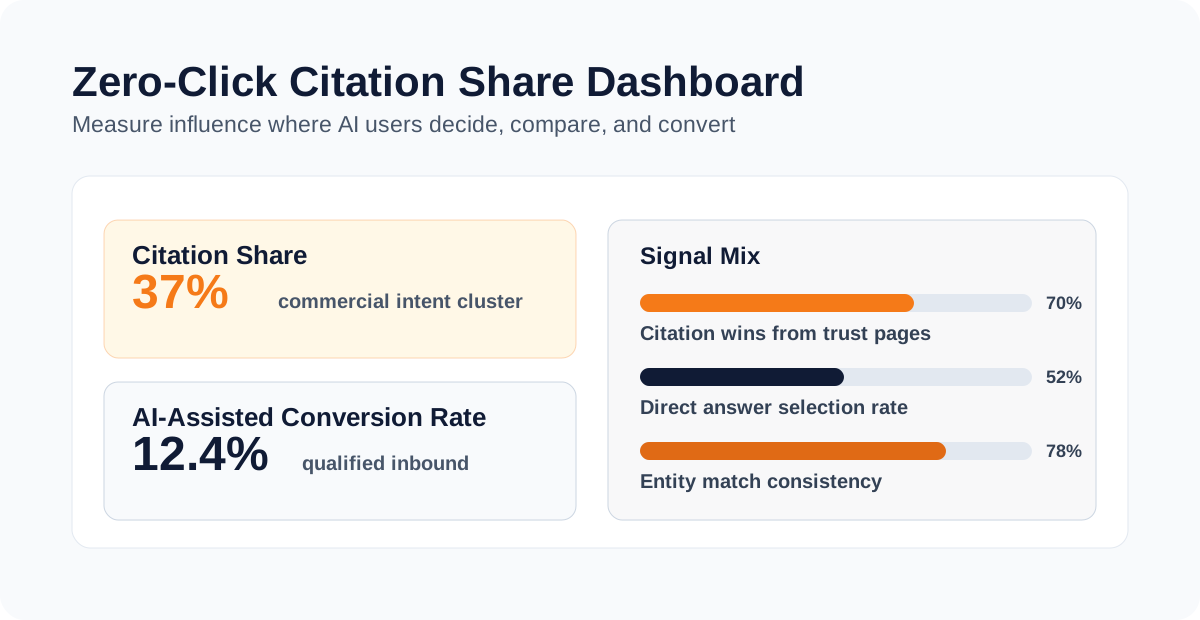
In AI interfaces, traffic is no longer the only KPI. Measure citation share, trust engagement, and qualified demand from recommendation pathways.
Shift Your Metrics from Clicks to Citation Share
Zero-click behavior is growing. Measure influence where users make decisions:
- Brand mention rate in AI answers
- Citation share for commercial and problem-aware queries
- Qualified inbound from trust and comparison prompts
Operational KPI Shift
Track citation share weekly, then compare assisted conversions from AI-referred sessions to standard organic traffic. This view gives better signal quality than rankings alone when buyers research inside answer interfaces.
Why AI Recommendations Drive Better Pipeline
AI-led recommendations often produce higher intent demand because users arrive after synthesis and pre-comparison.
This changes acquisition strategy:
- Build citation-ready pages, not only traffic pages
- Publish trust and policy clarity as part of marketing content
- Connect SEO reporting with sales qualification signals
Recent Gartner analysis on generative AI in marketing and Deloitte digital trust reporting both reinforce the same direction - teams that connect trust, retrieval quality, and commercial reporting gain stronger decision velocity.
Strengthen Off-Site Entity Signals
Digital PR, expert mentions, and active participation in high-signal communities improve brand retrievability.
Priority channels:
- LinkedIn expert content
- Niche forums and community threads
- Authoritative media mentions and partner citations
For execution examples, review how citation-ready positioning supports growth across enterprise SEO agency selection and practical AI search usage in ChatGPT for SEO workflows.
Conclusion - The 30-Day Transition Plan
This transition plan helps teams move from fragmented SEO tasks to a trust-first search system that supports rankings, answers, and citations together.
Week One
- Audit crawl directives
- Validate schema baseline
- Map trust-page gaps
Week Two
- Refactor answer blocks
- Rebuild intent headings
- Improve internal pathing
Week Three
- Publish transparency page
- Document retention windows
- Clarify AI usage policy
Week Four
- Track AI brand mentions
- Benchmark citation share
- Prioritize high-impact pages
In 30 days, your goal is not perfect coverage. Your goal is an auditable trust layer that improves ranking stability, answer selection, and citation probability at the same time.
Frequently Asked Questions
Is AI data privacy really a ranking factor in 2026? +−
What should we prioritize first, SEO, AEO, or GEO? +−
How often should we update llms.txt and trust pages? +−
What is a good benchmark for citation share? +−
Can privacy-first content improve conversion, not just compliance? +−
How long does it take to see results from trust-first optimization? +−
Have questions about this article?
Ask the AI assistant anything — it has context on everything you just read.
AI Assistant
Ask about this article
I can summarize this article, explain concepts, and suggest related posts on SEOwebster.com.
Try asking