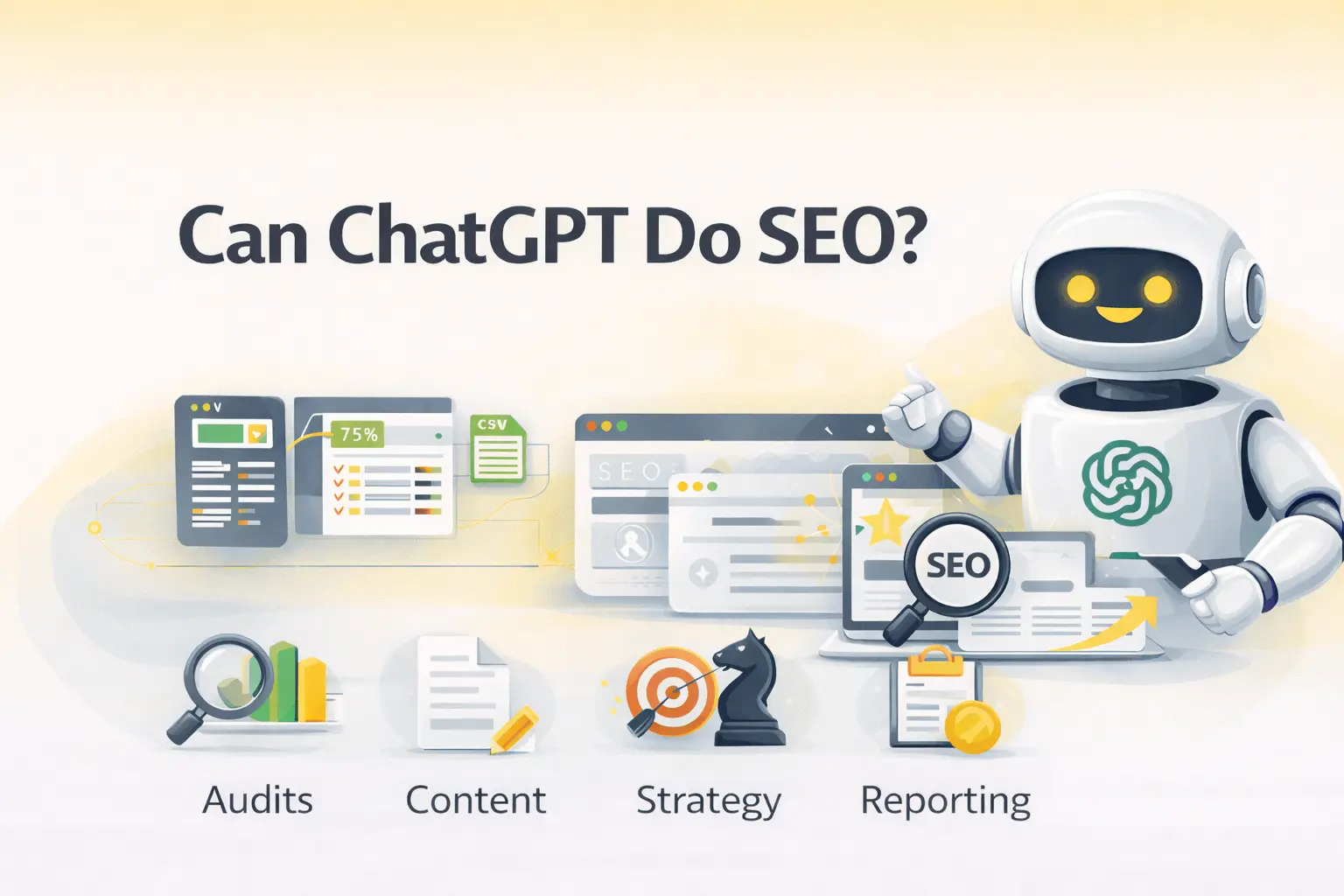
In 2026, ChatGPT for SEO has evolved from a simple text generator into a sophisticated SEO analyst. But here’s the critical distinction: it’s your assistant, not your pilot. The most successful SEO professionals aren’t asking ChatGPT to “write an SEO article about X.” They’re using it to process data, identify patterns, and execute structured workflows that would take humans days to complete.
OpenAI’s ChatGPT now supports Advanced Data Analysis (formerly Code Interpreter), allowing you to upload CSVs of keyword data, log files, and Google Search Console exports. This transforms it from a chatbot into a programmable SEO engine.
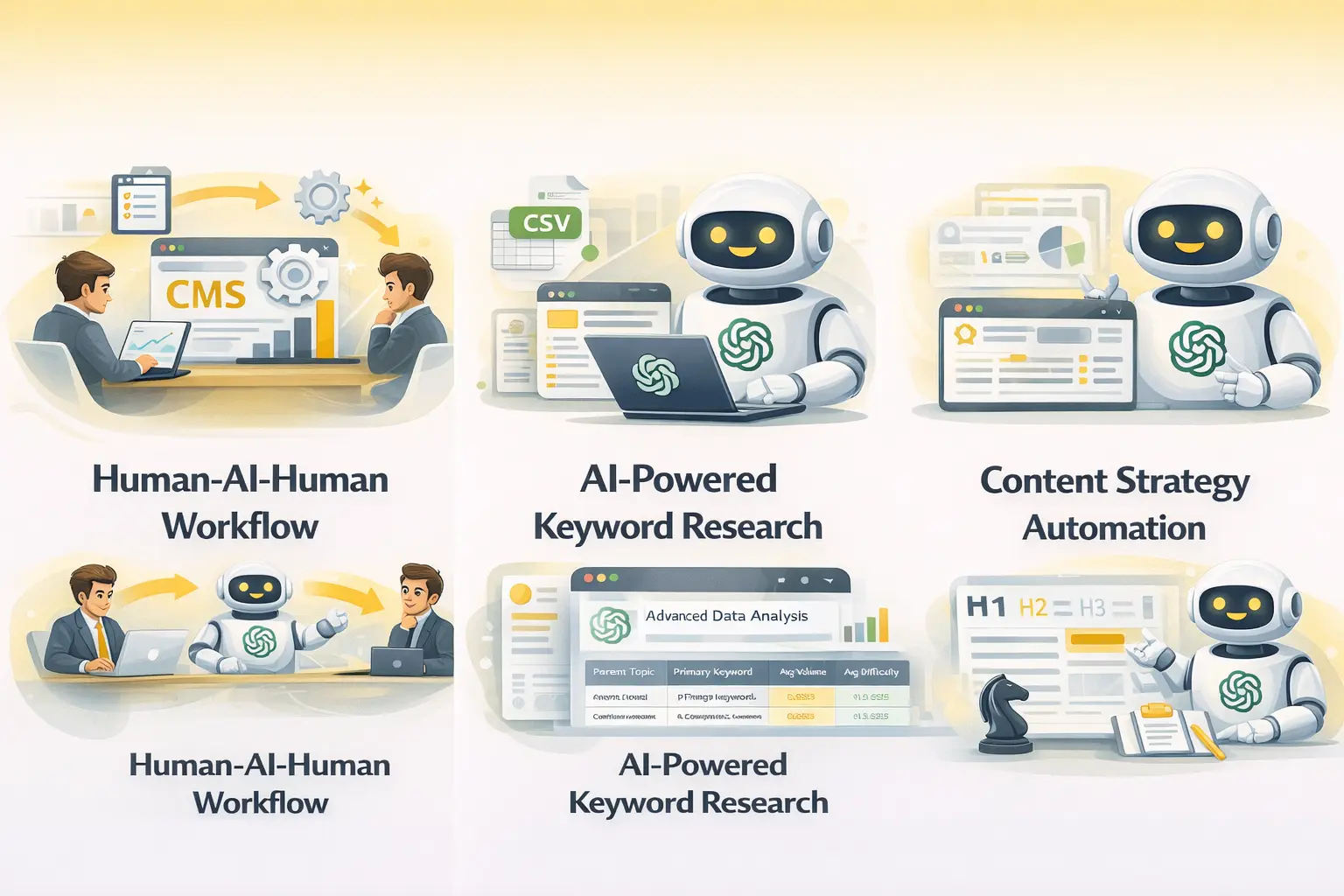
The Human-AI-Human Workflow
The winning formula for AI SEO strategy 2026 is simple: Human strategy → AI execution → Human polish. Never skip the first or last step.
According to Gartner’s 2026 research, 73% of marketing teams now use AI for content creation, but only 12% report it as “highly effective” without human oversight. The difference? Those 12% use structured workflows, not one-off prompts.
Keyword Research and Clustering
The first bottleneck in any SEO campaign is organizing chaos. You export 1,000 keywords from Ahrefs or SEMrush now what? Manual clustering takes days. Semantic keyword clustering with ChatGPT takes minutes. For comprehensive keyword research services, combining AI automation with expert analysis delivers the best results.
Upload and Cluster: The CSV Workflow
Here’s the exact workflow for automating SEO with ChatGPT:
Export Data
Export keyword data as CSV (Keyword, Volume, Difficulty)
Upload to ChatGPT
Upload to ChatGPT Advanced Data Analysis
Use Prompt
Use clustering prompt (see below)
Review Results
Review and refine clusters
Pro Prompt for Clustering:
Cluster these 500 keywords into topic groups based on semantic relevance.
Give each group a "Parent Topic" name, a primary keyword, and list supporting
keywords. Format as a table with columns: Parent Topic | Primary Keyword |
Supporting Keywords (comma-separated) | Avg Volume | Avg Difficulty.
This is topic cluster generation at scale. What used to require SEO analysts and spreadsheet gymnastics now happens in 30 seconds.
Intent Classification: Mapping the Buyer’s Journey
Raw keyword lists lack context. Is someone searching “SEO tools” ready to buy, or just learning? Bulk keyword intent classification solves this:
| Intent Type | User Behavior | Content Type | Example Keywords |
|---|---|---|---|
| Informational | Learning | Guides, Tutorials | "what is SEO", "how to optimize" |
| Commercial | Comparing | Reviews, Comparisons | "best SEO tools", "Ahrefs vs SEMrush" |
| Transactional | Buying | Pricing, Signup Pages | "buy SEO software", "Ahrefs pricing" |
Prompt for Intent Classification:
Analyze this keyword list and tag each keyword as Informational, Commercial,
or Transactional based on user intent. Add a "Funnel Stage" column (Top,
Middle, or Bottom of funnel). Export as CSV.
This ChatGPT SEO workflow maps keywords to the buyer’s journey automatically, helping you prioritize content that converts. Learn more about navigational vs transactional keywords to refine your intent classification strategy.
Finding “Topical Adjacencies”: The Blue Ocean Strategy
Competitor research often misses the adjacent topics concepts semantically related to your niche that others overlook. This is where AI excels at pattern recognition.
Prompt for Finding Content Gaps:
What topics are semantically related to [MAIN TOPIC] that SaaS companies in
this niche often overlook? Focus on "topical adjacencies" that would attract
the same audience but face less competition.
For example, a project management tool might discover adjacent topics like “async communication frameworks” or “remote team rituals” valuable, low-competition angles.
Pro Tip
Document your ChatGPT workflows by saving your prompts and results. This helps you refine your process and share successful patterns with your team.
Content Creation: The “Anti-Generic” Workflow
The #1 mistake in creating content briefs with ChatGPT is asking it to write full articles immediately. This produces generic, encyclopedia-style content that ranks nowhere. For professional content optimization services, expert editors can transform AI-generated drafts into ranking content.
The winning workflow? Briefs before drafts.
Step 1: Generate the Content Brief
Content Brief Prompt Template
This structured approach is the foundation of humanizing AI content. You’re not asking for generic text; you’re designing the architecture first.
Step 2: Content Gap Analysis Automation
Here’s where content gap analysis automation gets powerful. Paste a competitor’s article (or just their H2/H3 structure) and run this prompt:
Prompt for Gap Analysis:
Analyze this article structure. What sub-topics, perspectives, or data points
are missing that would make it significantly more helpful to the reader? Focus
on practical gaps, not just "add more words."
Common gaps ChatGPT identifies:
- Missing “Implementation” sections (theory without practice)
- Lack of failure scenarios or “what not to do”
- No tools/resources section
- Missing visual aids or examples
- Outdated statistics (pre-2026 data)
Step 3: Fact Density Optimization
Generic AI content is fluffy. Great SEO content is dense with specific, verifiable facts. According to Moz’s 2026 ranking factors study, pages with higher “fact density” (unique stats, quotes, or data points per 1,000 words) consistently outrank fluff.
Prompt for Fact Density:
Rewrite this section to increase fact density. Replace vague statements with
specific statistics, studies, or expert quotes. Cite sources where possible.
Remove AI fluff words like "delve," "landscape," "crucial," "unlock."
Provide specific feedback to writers on content quality, highlighting exactly where to add fact density and unique insights.
On-Page and Technical SEO: The Code Generator
This is where ChatGPT shines for technical SEOs. Generating code at scale used to require developers. Now it requires the right prompt. For comprehensive technical SEO services and on-page SEO optimization, combining AI automation with expert oversight ensures nothing falls through the cracks.
Schema Markup Generator ChatGPT
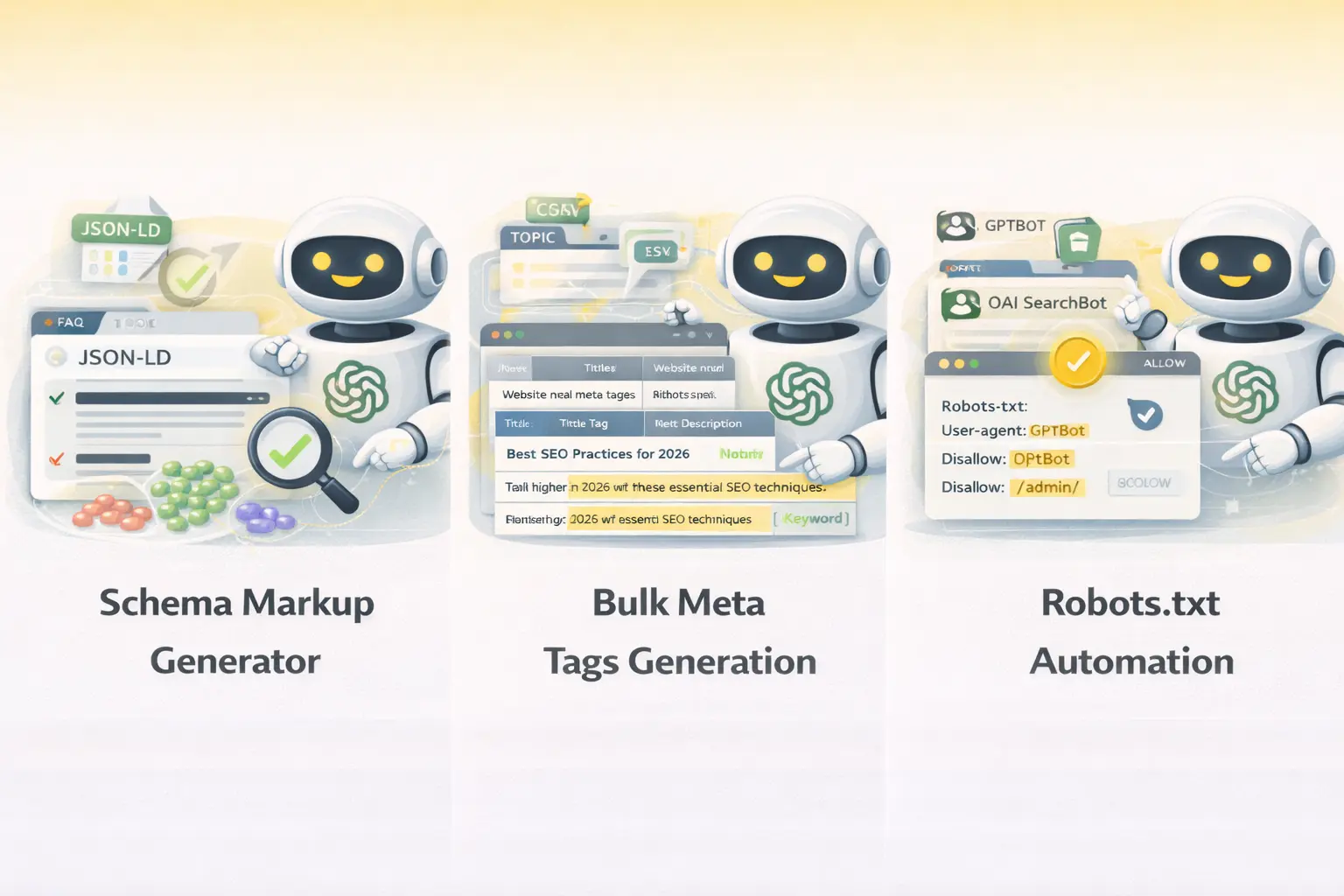
JSON-LD schema generation is tedious and error-prone manually. ChatGPT handles it perfectly every time.
FAQ Schema ▼
Prompt for FAQ Schema:
Generate valid JSON-LD FAQ schema for these questions and answers: 1. Q: [Question 1] A: [Answer 1] 2. Q: [Question 2] A: [Answer 2] 3. Q: [Question 3] A: [Answer 3]Ensure it passes Google’s Structured Data Testing Tool.
ChatGPT outputs clean, valid JSON-LD you can drop into your <head> tag. For structured data validation, always test the output at Schema.org’s validator.
How-To Schema ▼
Prompt for How-To Schema:
Generate valid JSON-LD HowTo schema for this step-by-step guide: Title: [How-To Title] Description: [Brief description] Steps: 1. [Step 1 description] 2. [Step 2 description] 3. [Step 3 description]Include estimated time, tools needed, and difficulty level. Ensure it passes Google’s Structured Data Testing Tool.
Perfect for tutorial content, recipes, and instructional guides. The How-To schema helps your content appear in Google’s rich results with step-by-step previews.
Organization Schema ▼
Prompt for Organization Schema:
Generate valid JSON-LD Organization schema for: Company Name: [Your Company] Website: [Your Website URL] Logo: [Logo URL] Description: [Company description] Social Profiles: - Facebook: [URL] - Twitter: [URL] - LinkedIn: [URL]Include contact information, address, and sameAs properties for all social profiles.
Organization schema helps establish your brand’s identity in search results and improves your chances of appearing in AI-generated summaries. Essential for Generative Engine Optimization (GEO).
Bulk Meta Tag Generation
Have 50 product pages that need optimized title tags and meta descriptions? Upload a CSV with columns: URL, Product Name, Main Keyword.
Prompt for Bulk Meta Tags:
Generate optimized Title Tags (<60 characters) and Meta Descriptions
(<155 characters) for each row. Make titles click-worthy using emotional
triggers while preserving the main keyword. Include year "2026" in descriptions
where relevant. Export as CSV with columns: URL | Title Tag | Meta Description.
This is bulk meta tag generation that maintains brand voice and keyword targeting across hundreds of pages. Before you push them live, spot-check the output with our free meta title and description checker to confirm each tag fits Google’s pixel limits. For large-scale content optimization, this workflow can save dozens of hours.
Robots.txt and OAI-SearchBot Blocking
In 2026, many sites are blocking AI crawlers to protect their content. ChatGPT can generate complex robots.txt rules instantly.
Prompt for Robots.txt:
Generate robots.txt rules to:
1. Block OAI-SearchBot (OpenAI's crawler)
2. Block GPTBot
3. Allow Googlebot and Bingbot
4. Disallow crawling of /admin/ and /api/ directories
For international sites, hreflang tag automation follows the same pattern upload your URL structure, specify languages/regions, and get valid hreflang tags.
Regex for Google Search Console
Writing Regular Expressions for GSC filters is notoriously tricky. ChatGPT handles it flawlessly.
Example Use Case
Problem: You want to filter all queries in Google Search Console containing your brand name OR common misspellings (e.g., "YourBrand", "Your Brand", "YrBrand").
Prompt:
Output: (yourbrand|your brand|yrbrand)
This is regex for Google Search Console made accessible to non-programmers.

The Audit: Analyzing Data - Performance
Advanced Data Analysis for SEO truly shines in auditing. Humans miss patterns; AI excels at spotting them. For comprehensive SEO site audits, combining AI-powered analysis with expert interpretation delivers actionable insights.
E-E-A-T Audit with ChatGPT
Google’s E-E-A-T guidelines (Experience, Expertise, Authoritativeness, Trustworthiness) are subjective. ChatGPT can audit them systematically. This complements professional on-page SEO audits that evaluate content quality holistically.
Prompt for E-E-A-T Audit:
Audit this article against Google's E-E-A-T guidelines. For each dimension
(Experience, Expertise, Authoritativeness, Trust), rate 1-10 and explain:
- What's missing
- Specific improvements (e.g., "Add author bio with credentials")
- Where competitors are stronger

[Paste article text]
The output identifies concrete gaps: missing author bios, lack of cited sources, no original research, etc.
GSC Data Analysis with ChatGPT
This is where automating SEO reports becomes a superpower. Export your Google Search Console performance data as CSV (Queries, Impressions, Clicks, CTR, Position). Upload to ChatGPT.
High Impressions, Low CTR Analysis ▼
Prompt:
Identify pages with >1,000 impressions but <2% CTR. For each, suggest:
1. Title tag rewrite (more click-worthy)
2. Why current title underperforms
3. Meta description improvement
This is CTR optimization triggers at scale finding your biggest quick wins.
Position 11-20 Opportunity Finder ▼
Prompt:
List all queries where we rank position 11-20 (page 2). Prioritize by: 1. Search volume (high first) 2. Relevance to our core offering 3. Keyword difficulty (estimate)For top 10, suggest what content improvements could push us to page 1.
These are your “low-hanging fruit” keywords close to page 1 but not quite there.
Cannibalization Detection ▼
Prompt:
Identify keyword cannibalization: cases where 2+ URLs rank for the
same query. For each case, recommend:
- Which URL should be the primary
- Whether to consolidate, noindex, or differentiate
- Internal linking changes
This is log file analysis with ChatGPT logic applied to GSC data surface hidden issues.
Log File and Crawl Error Analysis
Paste server logs or Screaming Frog error exports directly into ChatGPT:
Prompt for Log Analysis:
Analyze this log file excerpt. Identify:
1. Most common errors (404, 500, etc.)
2. Root causes (e.g., broken link patterns)
3. Priority fixes (most trafficked broken pages)
4. Suggested redirects (old URL → new URL mapping)
This is log file analysis with ChatGPT that saves hours of manual diagnosis. Document your analysis process to build a knowledge base for your team.
Reporting and Strategy: The Executive Summary
SEO reports are often too technical for stakeholders. ChatGPT translates geek-speak into executive language.
Automating SEO Reports
Upload your monthly report (traffic, rankings, conversions) and run:
Prompt for Executive Summary:
Summarize this SEO performance report for a non-technical executive.
Focus on:
1. What changed (in %)
2. Why it changed (1-2 key factors)
3. Business impact (revenue/leads)
4. What we're doing next (2-3 priorities)

Keep it under 200 words. Use "Plain English" with no jargon.
This is automating SEO reports for client presentations turning spreadsheets into stories. For agencies managing multiple clients, SEO consultation services can help structure these reports for maximum impact.
Competitor SWOT Analysis
Feed competitor content strategies into ChatGPT for a SEO SWOT analysis:
| Analysis Type | Input | Output |
|---|---|---|
| Strengths | Competitor sitemap, top pages | Topics they dominate |
| Weaknesses | Their content gaps vs. ours | Areas we can outrank |
| Opportunities | Market trends, new keywords | Blue ocean topics |
| Threats | New competitors, algorithm updates | Risk mitigation plan |
Prompt for SWOT:
Based on this competitor content list and our own, generate a SWOT analysis:
- Strengths: Where they lead
- Weaknesses: Where they're vulnerable
- Opportunities: Topics they're missing that we should cover
- Threats: What they're doing that could hurt our rankings
This is prompt engineering for SEO strategy, not just tactics.
Future-Proofing: Generative Engine Optimization (GEO)
The biggest shift in 2026 isn’t Google it’s optimization for AI search. ChatGPT Search, Perplexity, and Google’s AI Overviews are becoming primary discovery channels.
What is Generative Engine Optimization?
The Paradigm Shift
Generative Engine Optimization (GEO) is about being cited by AI, not just ranked by Google. According to Search Engine Journal, 34% of ChatGPT users never click through to source websites they trust the AI summary.
How to Rank in ChatGPT Search
The ChatGPT Search algorithm prioritizes:
- Citation Velocity: Frequently mentioned by authoritative sources
- Structured Data: Clear entities (Organization, Person, Product schema)
- Fact Density: Specific, verifiable claims with citations
- Recency: Updated content (timestamps matter)
GEO Optimization Checklist
Use digital PR strategies and off-page SEO services to increase your citation velocity getting mentioned on sites that AI models trust. Building quality backlinks from authoritative sources is essential for GEO success.
The Golden Rules: Using ChatGPT Responsibly
Rule #1: Never Trust Facts Without Verification
ChatGPT hallucinates statistics, dates, and citations. Always verify any factual claim before publishing. Use fact-checking services for statistical claims.
Rule #2: Protect Client Data
Don't input sensitive client data, PII, or proprietary strategies into ChatGPT's public chat. Use ChatGPT Enterprise for confidential work.
Rule #3: AI is a Force Multiplier, Not a Replacement
The best SEO results come from humans who know what to ask. ChatGPT handles execution and scale; you provide strategy and judgment.
Advanced Pro Prompts: Copy and Paste Templates
Here are battle-tested prompts for ChatGPT SEO workflow automation:
For Clustering:
For Internal Linking:
For CTR Optimization:
Document your best prompts in a shared document or knowledge base to create a prompt library for your team.
Frequently Asked Questions
How to use ChatGPT for SEO audits? ▼
Upload your page content or GSC data to ChatGPT Advanced Data Analysis. Use structured prompts like: "Audit this content against E-E-A-T guidelines" or "Identify high-impression, low-CTR queries and suggest title improvements." The key is feeding it structured data (CSV, HTML, or plain text) rather than vague requests.
Best ChatGPT prompts for keyword research? ▼
For semantic keyword clustering: "Cluster these keywords by topic and intent." For finding content gaps: "What semantically related topics are competitors missing?" For intent classification: "Tag each keyword as Informational, Commercial, or Transactional." Always provide context about your niche and goals for better results.
Can ChatGPT write regex for Google Search Console? ▼
Yes! ChatGPT excels at regex for Google Search Console. Example prompt: "Write regex to filter queries containing [brand] OR [misspelling]." It will generate patterns like (brand|misspeling) and explain how to apply them in GSC's query filter. Always test the regex in a regex validator first.
How to check E-E-A-T with AI? ▼
Paste your article into ChatGPT with the prompt: "Audit against Google's E-E-A-T guidelines (Experience, Expertise, Authoritativeness, Trust). Rate each dimension 1-10 and suggest specific improvements." It will identify missing author credentials, lack of citations, or weak trust signals. Cross-reference with Google's official guidelines.
Analyze Google Search Console data with ChatGPT? ▼
Export your GSC performance data as CSV (Queries, Clicks, Impressions, CTR, Position). Upload to ChatGPT and prompt: "Find pages with high impressions, low CTR" or "Identify keyword cannibalization." Advanced Data Analysis for SEO mode will run Python analysis, generate visualizations, and suggest optimizations automatically.
Can ChatGPT replace an SEO specialist? ▼
No. ChatGPT is a tool, not a strategist. It can't understand business context, make judgment calls about brand positioning, or adapt to algorithm changes it hasn't been trained on. Think of it as an analyst who executes tasks perfectly but needs direction. The human-AI-human workflow is essential strategy and oversight must come from experienced SEO professionals.
Is ChatGPT-generated content bad for SEO? ▼
Not if you follow the anti-generic workflow: briefs before drafts, fact density optimization, and human editing. Raw AI content is detectable and often generic. But AI-assisted content with human strategy, unique data, and expert polish performs well. Focus on humanizing AI content through editing, fact-checking, and adding original insights.
What is Generative Engine Optimization (GEO)? ▼
Generative Engine Optimization is the practice of optimizing content to be cited by AI models like ChatGPT Search, Perplexity, and Google's AI Overviews. Unlike traditional SEO (ranking in search results), GEO focuses on being the source that AI references in its generated answers. Key factors: citation velocity, structured data, fact density, and recency.
How to optimize for ChatGPT Search? ▼
To rank in ChatGPT Search: (1) Add comprehensive schema markup (Organization, Person, FAQ), (2) Build links from authoritative sources (citation velocity), (3) Include specific, verifiable facts with sources (fact density), (4) Keep content updated with recent timestamps. OpenAI's search documentation suggests focusing on trustworthy, well-cited content.
Can I use ChatGPT for competitor analysis? ▼
Yes! Feed competitor content structures, sitemaps, or keyword lists into ChatGPT for SEO SWOT analysis. Ask: "Compare this competitor's content strategy to ours. What are they doing better? Where are their gaps?" Or use it for finding content gaps with AI: "What topics do they cover that we don't?" This is especially powerful for reverse-engineering successful content strategies.
Should I upgrade to ChatGPT Plus for SEO work? ▼
Absolutely. ChatGPT Plus ($20/month) includes Advanced Data Analysis (file uploads), which is essential for automating SEO with ChatGPT. The free version can't analyze CSVs, run Python code, or process large data files all critical for keyword clustering, GSC analysis, and technical audits. For agencies, ChatGPT Enterprise adds data privacy and team features.
How do I train ChatGPT on my brand voice? ▼
Create a "Brand Voice Guide" document with examples of your best content, tone guidelines, and phrases you do/don't use. Upload it with every content generation request: "Write in the tone and style described in this guide: [paste document]." For consistent results, use custom GPTs (ChatGPT Plus feature) to save your brand voice as a reusable template.
Final Thought: The SEO Multiplier Effect
ChatGPT for SEO isn’t about replacing human expertise. It’s about amplifying it. What used to take a team of analysts a week clustering 1,000 keywords, auditing 50 pages for E-E-A-T, generating schema for 100 FAQs now takes a skilled SEO professional a few hours.
The winners in 2026 aren’t those with the best AI tools. They’re the ones who know what questions to ask.
As Search Engine Journal noted in their 2026 year-end review: “AI hasn’t democratized SEO expertise. It’s concentrated advantage in the hands of SEOs who master prompt engineering.”
Build your ChatGPT SEO workflow. Document your best prompts. Treat AI as your analyst, not your strategist. And always, always verify before you publish.
You can use SEO rank tracking tools to measure the impact of your AI-optimized content and continuously refine your approach. For comprehensive SEO strategy, consider professional SEO consultation to ensure your AI workflows align with business goals.
Related Articles:
- Best Digital PR Agencies for Citation Building
- Best SEO Rank Tracking Software 2026
- SEO Group Buy Tools for Budget-Conscious Marketers
- Advanced Link Building Techniques
- Keyword Intent Mapping for B2B Buyers Journey
Related Services:
Have questions about this article?
Ask the AI assistant anything — it has context on everything you just read.
AI Assistant
Ask about this article
I can summarize this article, explain concepts, and suggest related posts on SEOwebster.com.
Try asking