The best B2B marketing ROI comparison platforms in 2026 are Dreamdata, HockeyStack, HubSpot Marketing Hub, Ruler Analytics, Adobe Marketo Engage, Terminus, and Attribution App. If you need to connect long sales cycles, buying committees, and CRM revenue data, these are the platforms worth shortlisting.
In B2B, one deal can touch half a dozen channels before it closes. That is why spreadsheet reporting and last-click attribution fall apart fast in 2026.
Dark social, offline events, partner referrals, and multi-channel nurture all influence pipeline, but basic reporting usually misses them. If your team still trusts a single source of truth that only shows the final click, you are making budget calls with half the picture missing.
Here are the B2B attribution tools that actually connect your marketing activity to closed-won revenue, categorised by tech stack and reporting maturity.
Editor’s Note on Methodology: We evaluated these platforms based on native CRM integration depth, time-to-value, and practical implementation experience across real B2B marketing and RevOps workflows.
- Best Overall for Revenue Attribution: Dreamdata. Strong full-funnel attribution and CRM alignment for B2B teams.
- Best for Unified Marketing + Sales Data: HockeyStack. Excellent for account-level visibility and pipeline analysis.
- Best All-in-One Ecosystem: HubSpot Marketing Hub. Best when your CRM, automation, and reporting already live in HubSpot.
- Best for Enterprise ABM: Terminus or Adobe Marketo Engage. Better for larger teams with complex governance needs.
Why Tracking B2B Marketing ROI Is Harder And More Important in 2026
B2B ROI tracking is harder now because the buyer journey is longer, less visible, and more fragmented. A single deal may include a LinkedIn ad, an organic article, a webinar, a sales call, a demo, a procurement review, and several internal meetings before revenue is booked. If you only measure the last touch, you are measuring the end of the journey, not the journey itself.
The average B2B buying cycle can stretch from weeks to many months, and for higher-value deals it can be longer still. That matters because marketing influence compounds across time. A prospect may first discover your brand through search, return via a dark social recommendation, and convert only after several nurture touches and a sales sequence. Basic analytics tools rarely stitch that story together.
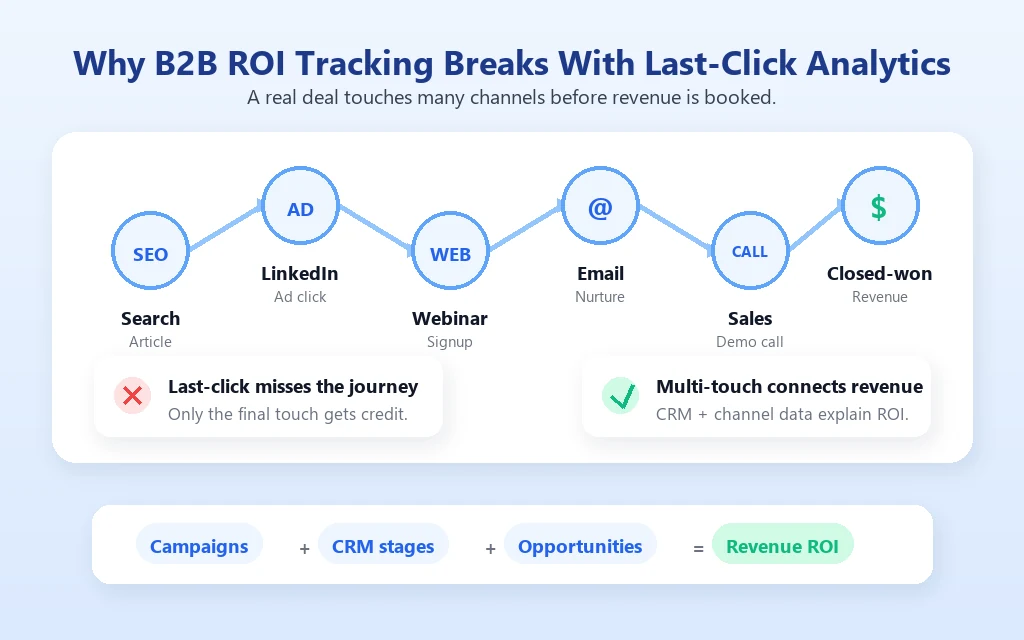
Three shifts make this even more urgent in 2026:
- Third-party cookies are weaker as a tracking foundation, which increases the need for first-party and CRM-connected measurement.
- Buying committees now include more stakeholders, so the last click is even less representative of the actual decision path.
- Dark social and private sharing hide a large portion of discovery and referral behaviour from standard web analytics.
The practical answer is stronger marketing-sales alignment. If Marketing, Sales, and RevOps do not agree on lifecycle stages, lead qualification rules, and source definitions, no attribution platform will save the reporting. The best B2B marketing ROI comparison platforms are revenue tools, not just dashboards.
If you are also refining your broader B2B strategy, see our guides on how to map keywords to the B2B buyer’s journey and keyword intent mapping for B2B buyers. For service-level support, our SaaS SEO services and Social Media SEO services pages show how we align demand generation with measurable outcomes.
Key Features To Look For In A B2B ROI Platform
These are non-negotiables in 2026. If a platform cannot handle them, it is not a serious B2B revenue attribution tool.
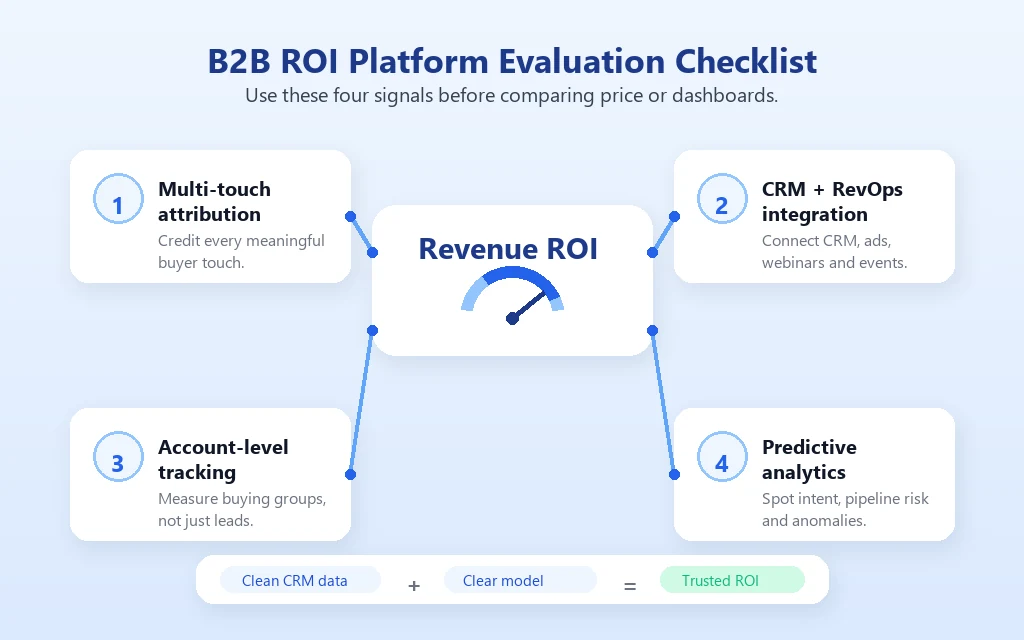
Multi-Touch Attribution Modelling
Single-touch reporting breaks B2B decision-making. You need a platform that can assign value across first touch, lead creation, nurture interactions, demo requests, and final conversion. Look for models such as linear, time decay, position-based, and custom rules.
Seamless CRM And RevOps Integration
If a platform does not integrate natively with Salesforce or HubSpot, it is not a true B2B ROI tool for most teams. The strongest platforms also connect to Marketo, LinkedIn Ads, Google Ads, webinar tools, and offline event workflows so your revenue view is not trapped in one channel.
Account-Based Marketing Tracking
ABM teams need account-level analytics, not just lead-level reports. That means identifying which buying groups engaged, which accounts converted, and how different stakeholders moved through the funnel. This is especially important when multiple people influence one opportunity.
AI-Driven Predictive Analytics
AI should help you interpret the data, not replace it. In a good platform, predictive analytics can highlight high-intent accounts, forecast pipeline contribution, and flag unusual shifts in campaign performance. It is most useful when combined with clean CRM data and clear lifecycle definitions.
Platform Comparison Summary Table
| Platform | Price | Best Feature | Target Audience |
|---|---|---|---|
| Dreamdata | Starts at $750/mo (Free tier available) | Revenue attribution depth | B2B teams proving marketing-sourced revenue |
| HockeyStack | Custom (Starts ~£1,400/mo, ~£28k/yr median) | Unified marketing and sales data | RevOps and leadership teams |
| HubSpot Marketing Hub | Free CRM available; Attribution requires Pro/Enterprise | All-in-one ecosystem | Teams already inside HubSpot |
| Ruler Analytics | Starts at roughly £199/mo; revenue tiers from ~£899/mo. | Online and offline source tracking | Lead gen and service-led B2B teams |
| Adobe Marketo Engage | Enterprise only. Typically starts at $3,000 to $5,000/mo depending on database size. | Scale and governance | Large enterprise marketing organisations |
| Terminus | Custom enterprise pricing. Historically scales from $2,500/mo upwards. | ABM ROI tracking | ABM-led revenue teams |
| Attribution App | Custom pricing. Usually scales from $1,000/mo based on event volume. | Custom attribution rules | Teams needing flexible modelling |
Top 7 B2B Marketing ROI Comparison Platforms (2026 List)
Vendor pricing shifts often. Where a number is not public, I have used a current pricing label rather than guessing. Check directly with the vendor before you buy.
Best For Comprehensive B2B Revenue Attribution
1. Dreamdata
Built for B2B teams that need a clear line from marketing activity to revenue.
Dreamdata is built for B2B teams that need a clear line from marketing activity to revenue. It is especially strong when you want attribution that connects anonymous web sessions, CRM objects, and pipeline outcomes without forcing your team to live inside spreadsheets.
Key Features:
- Multi-touch revenue attribution across campaigns and channels
- CRM and ad platform integrations for revenue reporting
- Journey analysis that helps identify which touches actually move deals
- Account and opportunity visibility for longer B2B sales cycles
Pros:
- Strong B2B-specific attribution depth
- Useful for teams that need revenue proof, not vanity metrics
- Good fit for RevOps-led organisations
Cons:
- Can be more than smaller teams need
- Requires clean CRM data to perform well
- Pricing is sales-led once you move beyond the free tier
Pricing:
- Starts at $750/mo
- Free tier available
Practitioner's Note:
- Requires clean Salesforce or HubSpot lifecycle data to function properly.
Best For Unified Marketing And Sales Data
2. HockeyStack
One view of marketing, sales, and account behaviour for faster reporting.
HockeyStack is a strong choice if you want one view of marketing, sales, and account behaviour. It is particularly appealing to teams that need faster reporting without stitching together several separate tools.
Key Features:
- Unified dashboards for marketing and sales performance
- Account-level attribution and journey analysis
- Pipeline, opportunity, and revenue visibility
- Useful segmentation for demand gen and ABM teams
Pros:
- Excellent for cross-functional reporting
- Clean interface for leadership reviews
- Strong fit for modern RevOps teams
Cons:
- Enterprise usage may need careful setup
- Smaller teams may not use every feature
- Public pricing is limited
Pricing:
- Custom
- Starts at ~£1,400/mo
- Median annual spend is ~£28k/yr
Practitioner's Note:
- Expect 4 to 6 weeks of setup if your CRM stages are messy or inconsistent.
Best All-In-One Ecosystem
3. HubSpot Marketing Hub
The easiest place to start if your organisation already runs on HubSpot.
If your organisation already runs on HubSpot, this is often the easiest place to start. HubSpot Marketing Hub is not the deepest attribution platform on this list, but it is compelling because CRM, automation, landing pages, and reporting sit inside one ecosystem.
Key Features:
- Native integration with HubSpot CRM
- Campaign reporting across email, landing pages, forms, and ads
- Automation and lifecycle stage management
- Solid reporting for small to mid-sized B2B teams
Pros:
- Very easy to adopt if you already use HubSpot
- Good all-in-one stack for lean teams
- Fast time to value
Cons:
- Less flexible than specialist attribution platforms
- Advanced reporting usually sits behind higher tiers
- Not ideal if your stack is spread across multiple systems
Pricing:
- Requires Pro/Enterprise tiers
Practitioner's Note:
- Useful only if your CRM ownership is tight; otherwise reporting quickly gets noisy.
Best For Closing The Loop On Offline And Online Data
4. Ruler Analytics
Useful when you need to connect website behaviour with lead and revenue data, including offline conversions.
Ruler Analytics is useful when you need to connect website behaviour with lead and revenue data, including offline conversions. It is strongest when your team is tracking UTM parameters, GCLID, and form fills across Salesforce or HubSpot.
That makes it attractive for B2B teams with phone calls, sales meetings, or forms that do not end in a direct online transaction.
Key Features:
- Lead source tracking tied to revenue outcomes
- Multi-channel attribution across digital and offline sources using UTM parameters and GCLID
- Native Salesforce and HubSpot integration to connect visits, leads, and opportunities
- Helpful for lead generation teams that need source clarity and cleaner first-party data capture
Pros:
- Strong for closing the attribution loop
- Practical for service businesses and lead gen teams
- Better than generic analytics for source tracking
Cons:
- Less broad than full revenue intelligence suites
- Needs disciplined first-party data capture and clean UTM governance
- Advanced use cases may require implementation support
Pricing:
- Starts at roughly £199/mo
- Revenue tiers from ~£899/mo
Practitioner's Note:
- Offline conversions only make sense when your sales team logs calls and meetings properly.
- If your UTM naming is inconsistent, the attribution story falls apart fast.
Best For Enterprise B2B Scaling
5. Adobe Marketo Engage
A heavyweight enterprise option for teams that need automation, governance, and complex reporting at scale.
Marketo Engage is a heavyweight enterprise option for teams that need automation, governance, and complex reporting at scale. It is best suited to organisations with mature operations, especially where Salesforce, Dynamics, or HubSpot data needs to be modelled at volume.
It becomes most useful when you care about deal cycle acceleration, lifecycle governance, and first-party data hygiene across large databases.
Key Features:
- Enterprise automation and lead management
- Attribution and campaign reporting capabilities across Salesforce, HubSpot, and Dynamics workflows
- Deep ecosystem fit for large organisations managing first-party data at scale
- Complex workflow and governance support that can improve deal cycle acceleration when it is configured properly
Pros:
- Powerful for enterprise-scale operations
- Strong for compliance and process control
- Suitable for complex buying journeys and large databases
Cons:
- Implementation can be heavy
- Often overkill for smaller teams
- Learning curve is steeper than lighter platforms
Pricing:
- Enterprise only
- Typically starts at $3,000 to $5,000/mo depending on database size
Practitioner's Note:
- Best for teams with an operations owner; without one, Marketo turns into admin debt.
- If your Salesforce fields are inconsistent, the reporting gets noisy very quickly.
Best For ABM-Specific ROI Tracking
6. Terminus
The logical choice when account-based marketing is central to your go-to-market strategy.
Terminus is a logical choice when account-based marketing is central to your go-to-market strategy. Rather than treating every lead as equal, it focuses on the accounts most likely to matter to revenue.
It is useful when your teams need account-level reporting tied to first-party data, sales activity, and pipeline velocity rather than generic lead counts.
Key Features:
- ABM-focused account engagement reporting
- Multi-channel account orchestration tied to first-party data and buying committee activity
- Campaign measurement for target accounts across Salesforce, HubSpot, and Dynamics integrations
- Strong fit for sales and marketing alignment when pipeline velocity is the main KPI
Pros:
- Great for ABM programmes
- Helps teams focus on target accounts
- Useful for account-level performance reviews
Cons:
- Less useful for teams without a clear ABM strategy
- Can be too specialised for broad demand gen
- May require process maturity to get full value
Pricing:
- Custom enterprise pricing
- Historically scales from $2,500/mo upwards
Practitioner's Note:
- Works best when target account lists are maintained properly and reviewed monthly.
- Terminus will not rescue weak account data, so first-party records need to be tight before launch.
7. Attribution App - Best For Custom Multi-Touch Modelling
Best For Custom Multi-Touch Modelling
Attribution App
A flexible option for teams that want to shape attribution around their own business logic.
Attribution App is a flexible option for teams that want to shape attribution around their own business logic. If you have custom channels, unique funnel stages, or a specific reporting framework, this kind of configurability can be useful.
It is best when you want a cleaner view of time-to-close metrics, CAC payback, and channel contribution without forcing your team into a rigid model.
Key Features:
- Custom multi-touch attribution models
- Marketing and pipeline reporting tied to first-party data and conversion paths
- Revenue-focused campaign analysis across Salesforce, HubSpot, and Dynamics inputs
- Useful when standard models are too rigid or too shallow for B2B buying cycles
Pros:
- Flexible attribution rules
- Good for teams with defined reporting logic
- Useful when you need more control than a generic dashboard offers
Cons:
- Requires a thoughtful setup
- Less recognisable than larger vendors
- May rely heavily on internal ownership
Pricing:
- Custom pricing
- Usually scales from $1,000/mo based on event volume
Practitioner's Note:
- If your funnel is messy, custom attribution logic will just expose the mess faster.
- You need consistent event naming and clean Salesforce field mapping before the model becomes useful.
How To Choose The Right Platform For Your Agency Or Enterprise
Start by auditing your current stack before you buy anything. List the systems that already hold your source of truth: CRM, marketing automation, ad platforms, webinar tools, event platforms, and finance or sales reporting.
If your pipeline data is fragmented, the new tool will only mirror that fragmentation in a nicer interface. That is how teams end up paying for a reporting layer that still produces arguments in the weekly pipeline meeting.
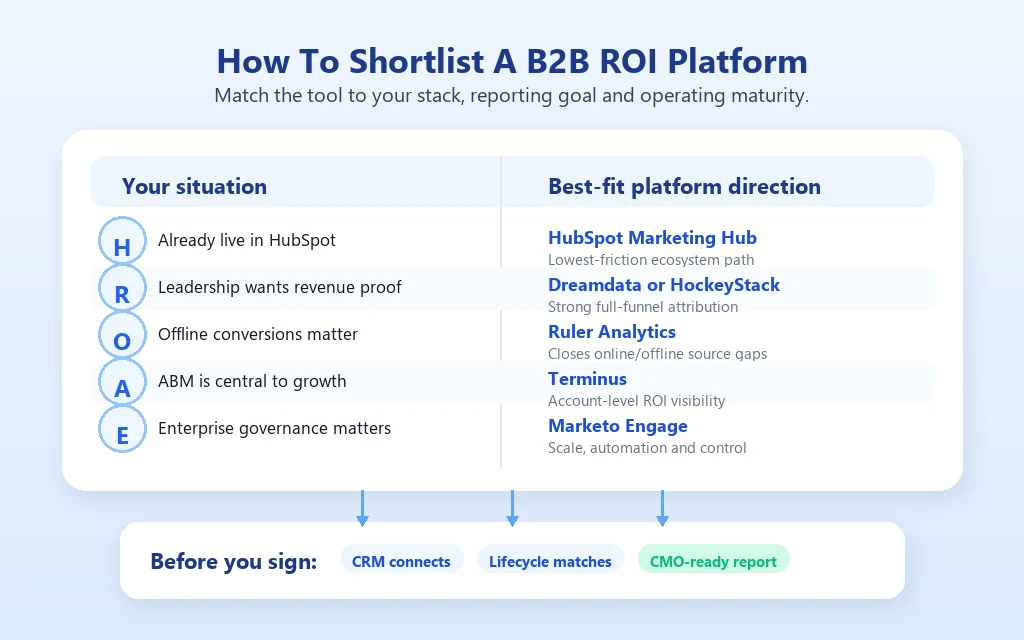
Use this framework to narrow the field:
- If you already live in HubSpot, HubSpot Marketing Hub is the lowest-friction path.
- If your leadership wants direct revenue proof, Dreamdata or HockeyStack are stronger fits.
- If offline conversions matter, Ruler Analytics deserves a close look.
- If ABM is central, Terminus should be shortlisted.
- If you need enterprise governance and broad marketing automation, Marketo Engage is the heavyweight option.
For agencies, the main question is whether the tool helps you report clearly to clients and prove value quickly. For enterprise teams, the question is whether it gives RevOps, Sales, and Marketing one trustworthy view of pipeline influence.
Implementation quality matters as much as the software itself.
Before signing a contract, test these three things:
- Can it connect to your CRM without complex custom work?
- Can it reflect your real lifecycle stages and opportunity definitions?
- Can your team explain the output to a CMO in under two minutes?
If the answer to any of those is no, keep looking.
B2B RevOps & SEO Consultation: If you want help auditing your attribution stack, fixing first-party data gaps, or aligning your SEO and RevOps reporting, contact SEO Webster for a practical consultation.
Frequently Asked Questions (FAQs)
What Is The Best Way To Track B2B Marketing ROI?
Why Is Google Analytics Not Enough For B2B ROI Tracking?
What Is Multi-Touch Attribution In B2B Marketing?
How Much Do B2B Marketing Analytics Platforms Typically Cost?
How Long Does It Take To Implement An ROI Tracking Platform?
Can These Platforms Track Offline Marketing Efforts?
How Does AI Improve B2B Marketing ROI Tracking?
The Verdict: Which ROI Tool Should You Deploy?
The best B2B marketing ROI comparison platforms do one thing well: they make revenue attribution understandable enough for Marketing, Sales, and RevOps to act on it.
That is the real test in 2026. Not whether a dashboard looks polished, but whether it helps you spend smarter, align teams, and defend budget with confidence.
Do not buy a £3,000/mo enterprise tool if your sales team still refuses to log their meetings. Fix your data hygiene first, then buy the software. Dreamdata and HockeyStack are strong choices for revenue-first teams, HubSpot is best for ecosystem simplicity, and the enterprise tools are there when governance and scale matter most.
If you are reviewing your own B2B measurement setup, audit your lifecycle stages, CRM hygiene, and channel tracking first. Then shortlist the platform that fills the biggest gap rather than the most features.
Have questions about this article?
Ask the AI assistant anything — it has context on everything you just read.
AI Assistant
Ask about this article
I can summarize this article, explain concepts, and suggest related posts on SEOwebster.com.
Try asking