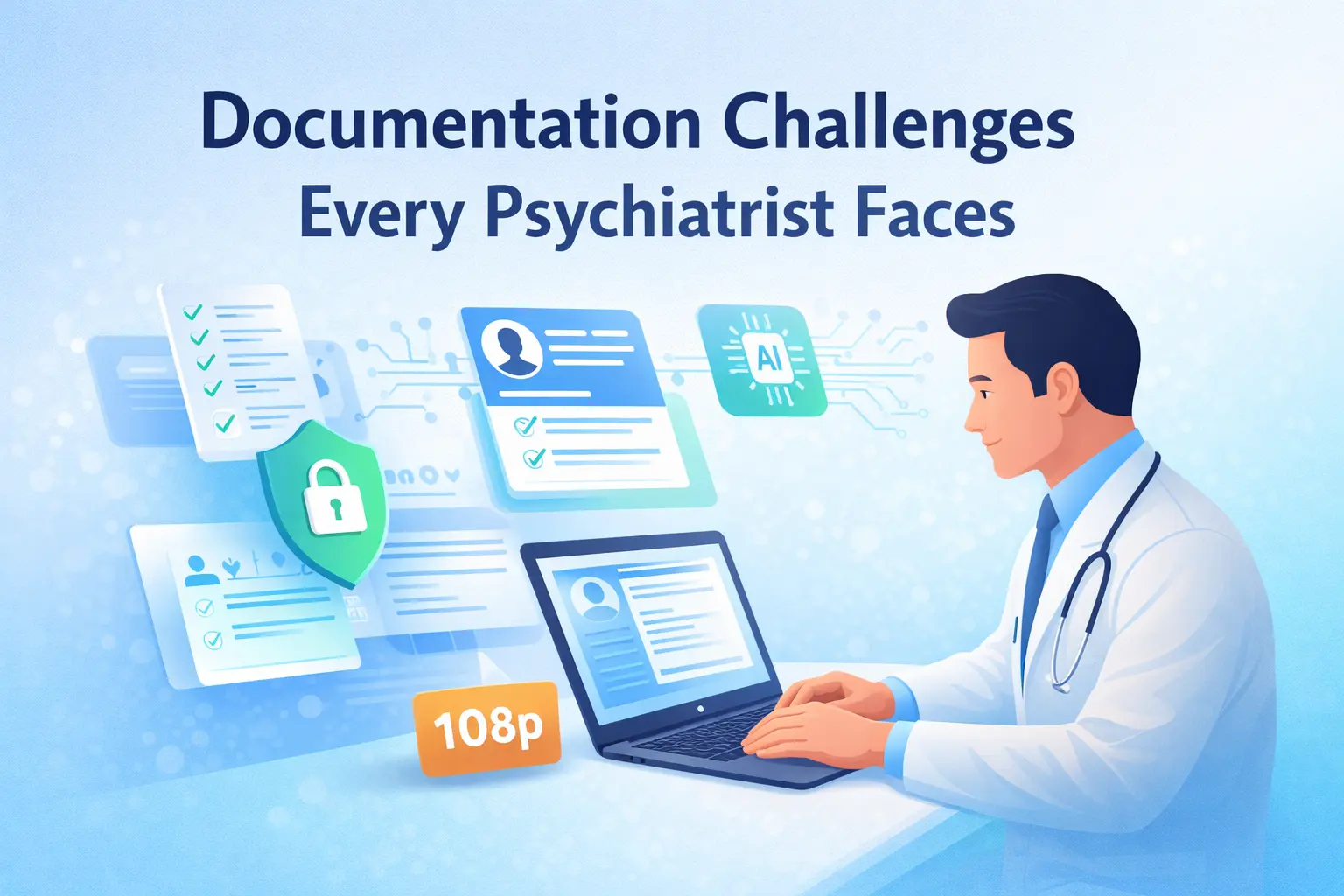
Psychiatric documentation is more than paperwork. It tells the story of a patient’s struggles, progress, risks, and care plan. But for many psychiatrists, keeping notes clear, complete, and timely can feel overwhelming.
Long sessions, sensitive topics, changing rules, and growing caseloads make it hard to stay on top of everything. A missed detail can affect care, compliance, or even legal safety. If you often find yourself finishing notes late or worrying about accuracy, you are not alone.
In this guide, we break down three high-impact documentation challenges and practical ways to address each one. We also cover additional pressure points that commonly affect note quality and clinician workload.
Challenge 1: Capturing Complex Mental Health Narratives in Limited Time
You are often balancing an impossible equation: psychiatric records need rich context, but appointments are finite.
The Time-Quality Documentation Paradox
Mental health care is rarely linear. There is no single lab result that summarizes family dynamics, trauma history, medication effects, functional changes, and subtle mood shifts.
At the same time, you need to remain fully present in the session. Most psychiatrists eventually face a difficult trade-off: prioritize clinical presence now, or write exhaustive notes later.
Practical Documentation Solutions That Save Time
Use technology to reduce clerical load, not clinical judgment. A psychiatry ai scribe can generate a structured draft while you focus on the patient. You still review and finalize the note, but the blank-page burden drops substantially.
One habit makes the biggest difference: document immediately after each session. Delayed notes take longer and are less accurate because details fade.
Template frameworks also help. Follow repeatable structures for routine visit types such as depression follow-ups, anxiety medication checks, and treatment response reviews. Standard structure preserves quality while reducing cognitive fatigue.
Challenge 2: Maintaining HIPAA Compliance While Preserving Clinical Detail
Fast notes are not helpful if they create privacy risk.
Balancing Privacy with Thoroughness
Psychiatric documentation requires both strong confidentiality controls and enough detail to support diagnosis, treatment continuity, and medical necessity.
Too little information weakens care coordination and reimbursement support. Too much unnecessary detail increases legal and privacy exposure.
HIPAA-Compliant Documentation Strategies
Apply the minimum necessary standard consistently. Include what is clinically relevant for treatment, billing, and operations, and avoid over-documenting personal details that do not support clinical decisions.
Use encrypted, healthcare-grade systems and verify Business Associate Agreements with every relevant vendor. Train all staff on privacy practices on a recurring schedule, not just at onboarding.
When AI-assisted tools are involved, confirm data handling policies, access controls, and retention settings. Confidentiality practices must be explicit, documented, and auditable.
Challenge 3: Documenting Suicide Risk Assessments Adequately
Suicide risk documentation carries some of the highest clinical and legal stakes in psychiatric practice.
Legal and Clinical Implications
Following adverse outcomes, risk assessment notes are often scrutinized in detail. At the same time, documentation burden contributes to clinician exhaustion, which can increase shortcuts and inconsistency.
In high-risk encounters, your note should show clear clinical reasoning, not just a checkbox outcome.
Creating Defensible Risk Assessment Records
Document the specific questions asked and the patient’s responses in concrete language. Record both risk factors and protective factors, and include direct quotes when clinically important.
Make your reasoning explicit. For example: despite moderate depressive symptoms, the patient reports no active plan, identifies strong family support, and agrees to a specific safety plan and weekly follow-up.
A complete risk note should include:
- Current ideation, intent, and plan status
- Access to means and any mitigation steps
- Protective factors and support system
- Safety plan details and emergency contacts
- Follow-up interval and rationale for level of care
Additional Documentation Pressures to Address
Beyond the three core challenges above, many psychiatrists also face:
- Proving medical necessity clearly for payer reviews
- Meeting controlled-substance documentation requirements
- Coordinating records across multiple providers and systems
These are operational challenges, but they directly affect clinical flow and legal defensibility.
Modern Solutions That Improve Psychiatric Documentation
AI-Powered Support Tools
The goal is not to type faster. The goal is to reduce repetitive work while improving consistency.
Ambient clinical documentation and NLP-supported drafting tools can structure information quickly, especially for common visit patterns. Used well, these systems give clinicians more time for direct care and higher-level decision-making.
Building Sustainable Documentation Practices
Technology alone is not enough. Strong results come from combining tools with workflow design:
- Run periodic documentation audits to identify quality gaps
- Use peer feedback for complex note scenarios
- Standardize protocols for frequent clinical situations
- Track documentation time, note quality, and clinician stress together
If one metric improves while the others deteriorate, the workflow still needs adjustment.
Moving Toward Sustainable Documentation
The documentation burden in psychiatry is unlikely to disappear, but it can become more manageable.
Start with one change: same-day note completion, template refinement, or an AI-supported workflow pilot. Measure outcomes after 30 days. Then iterate.
The goal is not perfect documentation. The goal is documentation that supports excellent care without consuming your clinical energy.
You did not enter psychiatry to become a full-time data entry specialist. A practical system can help you protect patients, stay compliant, and reclaim time for the work that matters most.
AI in Psychiatric Documentation: Where It Adds the Most Value
If you are aligning your practice with an AI-first healthcare workflow, focus on high-friction documentation moments rather than trying to automate everything at once.
The strongest use cases in psychiatry usually include:
- Session-to-note draft generation for follow-up visits
- Structured extraction of symptoms, side effects, and medication adherence
- Automatic formatting of risk assessments into consistent note sections
- Visit-summary generation for care coordination with other providers
In each case, AI should accelerate clinical writing, not replace clinical judgment. Final sign-off must always remain with the psychiatrist.
AI Governance Checklist for Mental Health Practices
As AI tools become common in behavioral health, governance quality becomes a competitive and compliance advantage. A lightweight governance checklist helps teams scale safely.
Use this operational baseline before full deployment:
- Confirm HIPAA compliance and signed BAAs for every AI vendor
- Verify encryption in transit and at rest for all note data
- Restrict access using role-based permissions and audit logs
- Define retention policies for raw audio, transcripts, and generated drafts
- Create a documented clinician review standard before notes are finalized
- Train staff to identify hallucinations, omissions, and context errors
Strong governance reduces legal exposure and improves clinician confidence in AI-assisted workflows.
Practical 30-Day AI Rollout Plan for Psychiatric Notes
Instead of introducing AI across all visit types immediately, run a focused pilot with measurable outcomes.
Week 1: Baseline and Scope
- Select one visit type such as medication management follow-ups
- Measure average documentation time per encounter
- Track current after-hours charting minutes per clinician
Week 2: Controlled Pilot
- Enable AI drafting for a small clinician group
- Require side-by-side review of generated notes before sign-off
- Log edit frequency and common correction categories
Week 3: Quality and Compliance Review
- Audit notes for completeness, risk documentation, and coding support
- Confirm privacy controls, access logs, and consent workflows
- Compare note quality against pre-pilot baseline
Week 4: Scale Decision
- Expand to additional visit types only if quality remains stable or improves
- Update templates based on pilot learning
- Publish internal documentation standards for AI-assisted note completion
This phased model protects care quality while helping teams realize productivity gains quickly.
AI Documentation Metrics That Matter Most
If you want AI adoption to be sustainable, track performance beyond speed alone.
Use a balanced measurement set:
- Time to close note after visit
- Same-day note completion rate
- Chart quality audit score
- Denial rate related to documentation insufficiency
- Clinician after-hours documentation burden
- Patient-facing time preserved per clinic day
A healthy AI program improves efficiency and documentation quality simultaneously. If speed improves while quality declines, recalibrate your templates, prompts, and review protocol.
Future Outlook: Human-Led, AI-Enabled Psychiatry Workflows
Psychiatric documentation is moving toward a hybrid model: clinicians lead assessment and decision-making, while AI supports structured capture, summarization, and consistency.
Practices that adopt this model intentionally are likely to gain three long-term advantages:
- Better continuity of care through clearer, more complete records
- Lower burnout by reducing repetitive documentation load
- Stronger legal defensibility through standardized, auditable documentation patterns
The best outcome is not fully automated charting. It is a workflow where psychiatrists spend more time thinking clinically and less time fighting documentation friction.
Frequently Asked Questions (FAQ)
How long should psychiatrists keep psychiatric medical records? +-
Can psychiatrists use AI scribes while maintaining patient confidentiality? +-
What are common documentation mistakes that increase malpractice risk? +-
How can psychiatrists reduce documentation time without sacrificing quality? +-
What documentation is required when prescribing controlled substances? +-
Have questions about this article?
Ask the AI assistant anything — it has context on everything you just read.
AI Assistant
Ask about this article
I can summarize this article, explain concepts, and suggest related posts on SEOwebster.com.
Try asking