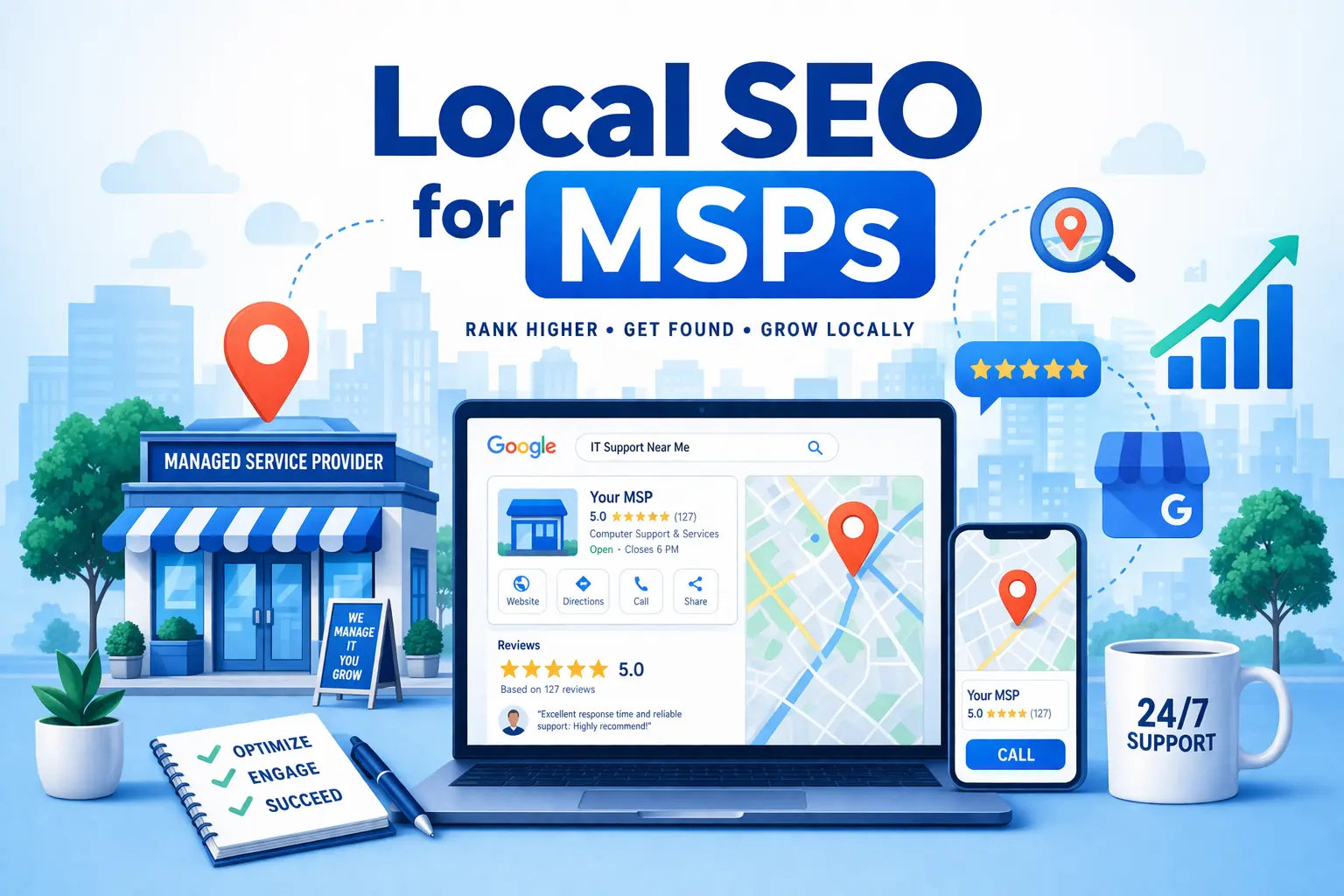
46% of all Google searches are looking for local information. Think about that for a second. When wifi goes down or a server crashes, business owners aren’t browsing LinkedIn for a provider. They’re pulling out their phone and searching for “IT help near me.” Out of pure frustration and urgency, 60% of them will click one of the first three results that show up. That’s it. Three results. Your MSP local SEO strategy is the difference between having dozens of ready-to-buy leads come to you every single month and making hundreds of cold calls just to book a single appointment.
The truth is, most MSPs don’t have a local SEO strategy that actually works. They set up a website, maybe claim their Google Business Profile, and then wonder why the phone doesn’t ring. To help with this, we partnered with DYAD’s local SEO team, to create a 9-step framework that managed IT service providers can steal to generate real inbound leads.
- Optimize your Google Business Profile
- Actively manage your Google Business Profile
- Systematically acquire new Google Reviews
- Create and optimize a network of local landing pages
- Publish blog content about local attractions and landmarks
- Publish blog content tailored towards local interests
- Get listed in credible local business directories
- Network with local business owners to acquire backlinks
- Build backlinks with non-local high-authority websites
1. Optimize Your Google Business Profile
Your Google Business Profile is the foundation of local SEO for MSPs. It’s the first thing potential clients see when they search for IT services in your area, and it’s what determines whether you show up on Google Maps or disappear into page two where nobody looks. If you haven’t claimed and fully optimized your GBP, stop reading and go do that right now.
A fully optimized profile looks like:
- Choose the correct primary category (e.g., “Managed IT Services”) and add up to 9 relevant subcategories.
- Use a valid, staffed address. No P.O. Boxes.
- List all services with keyword-rich names that reflect how people actually search.
- Write a 750-character description that includes your location, your service area, and your core services.
This is foundational. Every other piece of your MSP local SEO strategy builds on top of this.
2. Actively Manage Your Google Business Profile
Optimizing your GBP is step one. Managing it is the ongoing work that most MSPs skip entirely and it costs them rankings. Google rewards profiles that show consistent activity, which means you need to treat your GBP like a living, breathing marketing channel.
That means:
- • Post updates regularly: Share blog posts, company news, and service highlights directly to your profile.
- • Respond to every single review: Respond to every single review, positive or negative, within 24 hours.
- • Keep your business information current: Your name, address and phone number need to be identical everywhere they appear online. NAP consistency is a direct ranking factor.
- • Add new photos and videos: Add new photos and videos of your actual team, your office, your work. Regularly. Stock photos won’t cut it.
3. Systematically Acquire New Google Reviews
Reviews matter more than most MSPs realize. But here’s the thing people get wrong: review velocity matters more than review volume. Google doesn’t just want to see that you have 200 positive reviews. It wants to see that you’re consistently earning new ones. A steady stream of fresh reviews builds trust with both the algorithm and your potential clients.
So how do you systematize it? Two methods that work:
Automate the Ask
Trigger an automated review request workflow off the back of every “Great” support ticket. Tools like CrewHu can handle this. The ticket closes, the client gets a prompt, the review rolls in. Simple.
Incentivize Your Team
Every Google review where a team member is mentioned by name earns that employee $100 toward their Christmas bonus. Now your clients want to leave a review and your team wants to ask for one. That’s a high quality feedback loop that pays for itself.
4. Create and Optimize a Network of Local Landing Pages
This is where your MSP local SEO strategy starts to compound. Someone searching “Managed IT Cincinnati” has a completely different intent than someone searching “IT Support Minneapolis.” And someone searching “Managed Cybersecurity in Cincinnati” is a different buyer entirely. You need specific local landing pages for each service in each city you serve.
The step-by-step:
Use SEMrush or Ahrefs to conduct keyword research. List your main services and all the different ways someone might search for them. Rotate through each city in your service area to generate hundreds of local keywords.
Group keywords by search intent and build a dedicated service page for each cluster.
Develop a standard geo page template on your website, then scale it across locations. Same structure, different text and images.
When these pages interlink properly, you create content silos that pass link juice between related pages. Google loves this. It creates a location based authority engine that gets stronger over time.
5. Publish Blog Content on Local Attractions and Landmarks
This one surprises people. Why would an MSP write blog posts about local attractions? Because it establishes topical authority over your specific geography. Think of it like proving to Google that you really are an expert on this location, not just a company that slapped a city name on a generic page.
Pull a list of high-volume, low-difficulty keywords that relate to local attractions in your target city. Consider a guide like “Top 10 Things to Do in [City].” Each supporting page should link to one other supporting page and one primary geo page. We typically build 5–6 supporting pages per geo page. So if you have 4 geo pages for a single city, that’s up to 20 supporting blog posts feeding into your local market rankings.
6. Publish Blog Content Tailored Towards Local Interests
Same playbook as above, but now you’re writing about topics that are relevant to the local business community. Think: cybersecurity case studies tied to regional industries, tech trends affecting local employers, or compliance topics that matter in your market. This is another layer of your MSP local SEO strategy that competitors almost never think about.
7. Get Listed in Credible Local Business Directories
Directory listings are a foundational piece of any local SEO strategy for MSPs. They reinforce your NAP consistency and generate referral traffic from platforms your potential clients are already browsing. Our favorites: Clutch, CloudTango, and Yelp. Each one carries weight in the local directories that matter for IT service providers.
8. Network with Local Business Owners to Build Backlinks
Backlinks are objectively one of the strongest ranking factors in local SEO for MSPs. They act as trust signals that verify your authority on a specific topic and in a specific geography. If you want your geo pages to rank for competitive keywords, you need backlinks pointing at them. Period.
Here’s how to build them through your local network:
- • Make a list of customers and partners you have a strong relationship with. Business owners tend to know other business owners.
- • Pitch the backlink exchange as mutually beneficial. Name a specific page on their website that could benefit from a link.
- • Do all the heavy lifting yourself. Write the blog for both companies, add the links, and hand it off so all they have to do is hit publish.
Your MSP local SEO strategy lives and dies by your ability to build real relationships that turn into real backlinks. Don’t skip this step.
9. Build Backlinks with Non-Local High-Authority Websites
Sometimes local backlinks aren’t enough. If you’re in a major city, chances are you’re going head-to-head against other MSPs that have an SEO agency behind them. You need an extra gear.
Here are a few methods that we use at SEOWebster:
- High-volume outreach: Use SEMrush to pull a list of websites linking to your competitors. Reach out and pitch better content to replace what they’re currently linking to.
- Purchase guest posts: A guest post is a blog you write for someone else’s website in exchange for a do-follow link. Yes, you’re doing the work and paying for the placement. That’s how valuable backlinks are.
- Broaden your network: Network with businesses outside your local area and repeat the link exchange process to expand your backlink profile beyond the local market.
Final Thoughts on MSP Local SEO Strategy
Search is evolving fast. After Google rolled out AI Overviews, brands across every industry saw a significant drop in organic clicks. The spray-and-pray approach to SEO is dead. Your MSP local SEO strategy needs to be specific, layered, and relentless. You need a clear local SEO strategy for MSPs that builds authority across every channel Google uses to evaluate local relevance.
And here’s the thing about GEO and AI Overviews: they’re essentially another platform to optimize for, just like Google itself. If your brand is ranking organically and showing up in third-party listicles and local directories, you’ll show up in AI-generated results too. Your MSP local SEO strategy is the foundation all of that gets built on.
These 9 steps work. We’ve seen them work for MSPs across the country. The question isn’t whether this framework delivers results. It’s whether you’re willing to execute it.
Frequently Asked Questions (FAQ)
How long does it take for an MSP to see results from local SEO? +−
Can I do local SEO for an MSP without a physical office? +−
Is review velocity or review volume more important? +−
Have questions about this article?
Ask the AI assistant anything — it has context on everything you just read.
AI Assistant
Ask about this article
I can summarize this article, explain concepts, and suggest related posts on SEOwebster.com.
Try asking