The short answer: Ahrefs generates an estimated $149M to $155M in annual recurring revenue (ARR) as of 2026, with zero venture funding, roughly 170 employees, and profit margins most SaaS companies would kill for. It isn’t just one of the most popular SEO tools; it is one of the most financially efficient B2B software businesses ever built. Below is a full breakdown of how it got there, how the business model works, and whether the price tag is still worth it in 2026.
Plenty of SEO tools promise the world and burn through VC money to do it. Ahrefs took the opposite route. If you want to understand why the best SEO tools often come with a premium price, Ahrefs is the cleanest case study around.
- Estimated ARR: $149M to $155M (2026)
- Funding: $0 and 100% bootstrapped
- Profitable since: 2017
- Revenue per employee: $880K to $1M+ (est.)
Section 1: The Bootstrapped SEO Powerhouse
I’ve been tracking the SEO tools market for years, and Ahrefs is the one company that consistently breaks the standard SaaS playbook. No Series A. No growth-hacking team. No IPO filing. Just product.
Founded in Singapore in 2011 by Dmytro Gerasymenko, Ahrefs started as a dead-simple backlink index. The initial build cost around $300,000, which was Gerasymenko’s own capital. Today it’s what the SaaS world sometimes calls a “centicorn”: a bootstrapped business that crossed $100M ARR without a single outside dollar.
| Data Point | Details |
|---|---|
| Founded | 2011 |
| CEO / Founder | Dmytro Gerasymenko |
| Estimated ARR (2026) | $149M to $155M |
| Funding Status | $0 and fully bootstrapped |
| Team Size | ~170+ employees |
| Headquarters | Singapore |
| Profitable Since | 2017 |
What makes this story compelling for SEOs specifically: Ahrefs doesn’t just sell an SEO platform, it practices what it preaches. Its content marketing, run by CMO Tim Soulo, is a masterclass in product-led growth. The blog ranks for arguably the most competitive SaaS keyword category on the planet, and it does so with a team of two dozen writers, not two hundred.
Section 2: Ahrefs Revenue Growth. 2010 to 2026
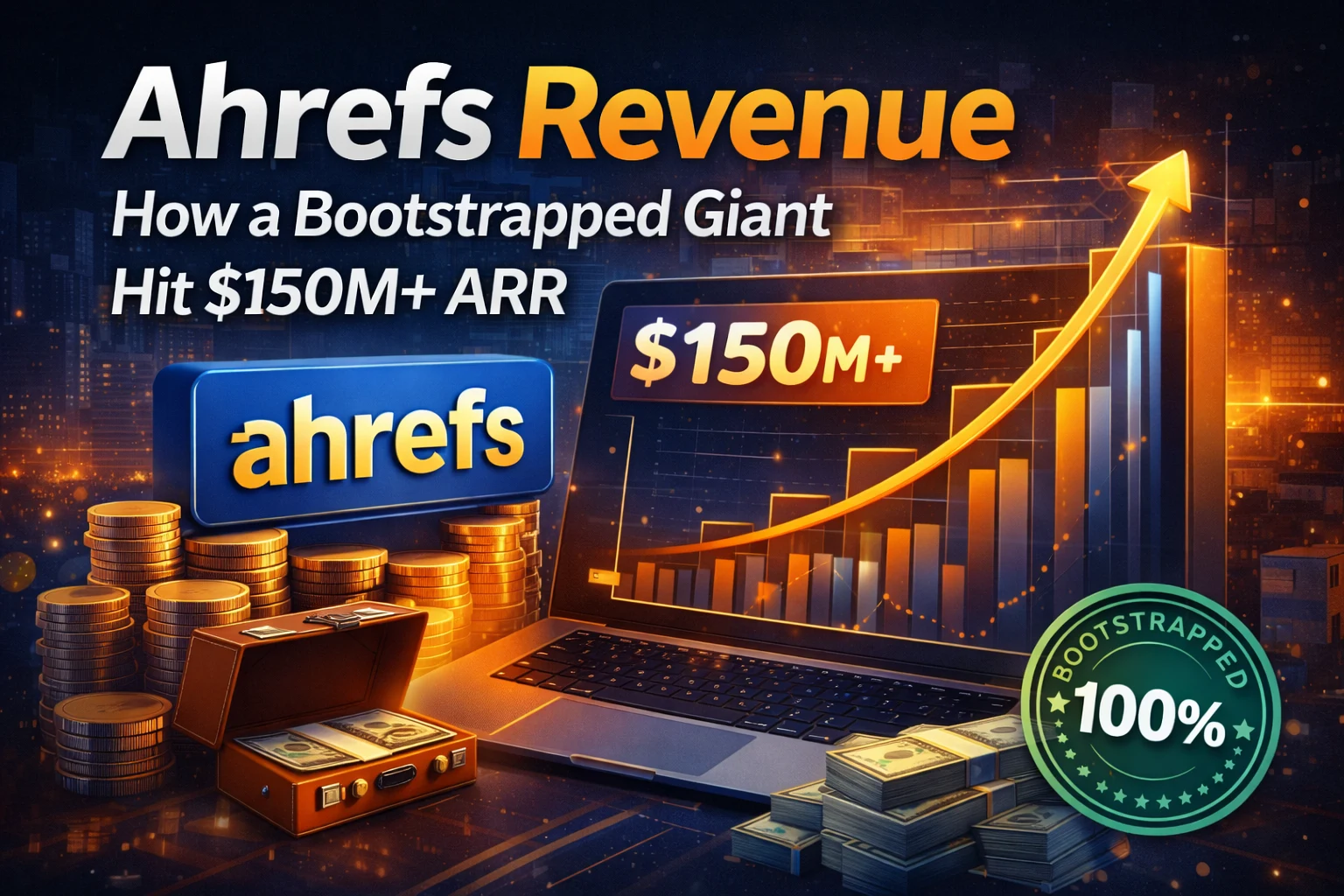
Infographic: The evolution of Ahrefs from a $300K seed investment to a $150M+ ARR powerhouse.
The Ahrefs origin story isn’t glamorous. No Silicon Valley garage, no angel investors, no demo days. Gerasymenko built the first version of the backlink crawler in Ukraine with his own savings and launched in 2011. Revenue was negligible for the first two years because the product was simply rebuilding its index.
The Key Milestones
How Ahrefs went from $300K seed money to a nine-figure ARR:
2011 to 2013: Building the Crawler
Invested all capital into server infrastructure and building a proprietary web crawler. Revenue was minimal, as the focus was on data quality above all else.
2014 to 2017: Scaling to $10M ARR
Word-of-mouth growth in the SEO community. The blog became a serious traffic asset. Reached profitability in 2017, a milestone they have maintained every year since.
2018 to 2021: The $50M Crossing
Rapid product expansion. Keywords Explorer, Content Explorer, Site Audit, and Rank Tracker launch or significantly mature. Ahrefs crosses the $50M ARR threshold during this window.
2022 to 2026: $100M+ and Counting
The controversial 2022 per-seat pricing shift accelerated enterprise revenue. Third-party estimates put Ahrefs at $149M ARR in 2024, likely crossing $150M+ by mid-2026.
The profitability point is worth dwelling on. Most SaaS companies at this scale have burned hundreds of millions in their race to $100M ARR. Ahrefs did it on cashflow. That is not a minor detail; it fundamentally changes every business decision they make, from how they price to which features they build.
Section 3: How Does Ahrefs Make Money? (Business Model Deep Dive)
Ahrefs’ revenue model is straightforward by design: sell subscriptions, don’t over-hire, and reinvest into infrastructure and product.
Current Subscription Tiers (2026)
| Plan | Monthly Price | Best For | Seats Included |
|---|---|---|---|
| Lite | $129/mo | Freelancers, small site owners | 1 |
| Standard | $249/mo | Growing agencies, in-house teams | 1 |
| Advanced | $449/mo | Large teams, multiple clients | 1 |
| Enterprise | $14,990/yr | Enterprises, large-scale SEO ops | 5+ |
The 2022 Per-Seat Pricing Shift
This is the move that generated the most controversy in the SEO community since Google’s Penguin update. In 2022, Ahrefs migrated from a model where teams could share logins to a per-seat system. Additional users cost $40 to $60 per month on top of the base subscription.
The community reaction was vocal. Twitter threads, Reddit complaints, and churn threats. But the revenue data tells a different story: per-seat pricing is one of the most effective expansion revenue mechanisms in B2B SaaS. When an agency goes from one login to five, that is $200 to $300 per month in incremental MRR per account, without acquiring a single new customer. Ahrefs knew exactly what it was doing.
Product-Led Growth (PLG): The Blog as a Sales Funnel
This is the piece most competitors have tried and failed to replicate. Tim Soulo, Ahrefs’ CMO, turned the Ahrefs blog into what’s effectively a full-funnel acquisition machine. Articles like “How to Do Keyword Research” don’t just educate; they are written to rank, to demonstrate the product in action, and to convert readers directly.
The result: Ahrefs has virtually no traditional sales team. No SDRs cold-calling prospects. No outbound email sequences. The blog ranks for tens of thousands of industry keywords and feeds users directly into trial signups. It’s product-led growth executed at a level that most PLG consultants only describe in theory.
Section 4: Why Is Ahrefs So Expensive?
I get this question constantly. People look at $249/month and compare it to a $49/month competitor and wonder what they’re paying for. Here’s the honest answer.
The $122M Server Bet
Ahrefs has publicly stated they’ve invested over $122 million in on-premise server infrastructure rather than using AWS, Google Cloud, or Azure. That is not a rounding error; it is a deliberate philosophical and financial decision.
Running your own data centers is expensive upfront. But at scale, the operating costs undercut cloud pricing significantly. More importantly, it means Ahrefs controls its own data. No cloud provider can throttle their crawler, increase storage costs, or create a conflict of interest. For a company whose entire product is data, that control is strategic.
Ahrefs Bot: The World’s Second-Most Active Crawler
Most people don’t realize that Ahrefs runs the second-most active web crawler on the internet after Googlebot. The Ahrefs Bot crawls billions of pages continuously to maintain its backlink index and keyword database. That infrastructure, including power, bandwidth, hardware amortization, and engineering, is priced into every subscription.
When you pay for Ahrefs, you’re partly paying for a data collection operation that rivals small search engines in scope.
Data Quality: The “Clean Data” Premium
Agencies that run large-scale link audits know the difference between dirty and clean backlink data. Some tools index everything indiscriminately. Ahrefs has built a reputation for data quality. Their disavow workflows, link quality scores, and domain rating algorithm are trusted by practitioners who’ve seen what bad data does to a campaign.
That reputation has a price. And frankly, for agencies billing clients $5,000 to $20,000 per month on SEO retainers, the $449/month Advanced plan is not a meaningful cost; it is a line item.
The $400M Cloud Savings Calculation
This is the number that tends to surprise people. Ahrefs hasn’t just spent $122M on servers; by doing so, they’ve avoided what their own engineering team estimated at $400M+ in cumulative cloud costs.
Here’s the math in broad strokes. Ahrefs’ data operation involves:
- Petabytes of backlink and crawl data stored and queried constantly
- Billions of HTTP requests per day from the Ahrefs Bot
- High-frequency database writes as their index refreshes
- Serving millions of API queries from active subscribers
On AWS or Google Cloud, petabyte-scale storage, egress bandwidth, and compute for real-time query serving compounds quickly. A conservative estimate for an equivalent cloud workload at Ahrefs’ scale: $3 million to $8 million per month in cloud bills, or $36 million to $96 million per year. Over a decade of operation, that’s well past $400 million, and cloud prices don’t go down as your data grows; they scale with it.
Owning the hardware flips the cost model. After the initial capital expenditure, marginal storage costs approach zero. The $122M investment is a one-time sunk cost; the $400M+ is what they’d be writing checks for annually by now if they’d gone cloud-native.
For users, this matters because it funds data freshness. A cloud-dependent Ahrefs would face constant pressure to reduce crawl frequency to control costs. An infrastructure-owning Ahrefs can crawl aggressively because the marginal cost of additional crawls is hardware depreciation, not a metered bill.
Technical note: Ahrefs' crawler uses a custom distributed crawling architecture. Unlike most SaaS tools that rely on third-party data partnerships, Ahrefs' link index is first-party, meaning the data pipeline runs from web page to Ahrefs database with no intermediaries. This has real implications for freshness and accuracy. Their index refreshes billions of backlinks daily, which is why you'll often see new links appear in Ahrefs hours before competing tools surface them.
Section 5: Ahrefs vs. Semrush. The Revenue Battle (Data Deep Dive)
The comparison that comes up constantly in SEO forums: which is more successful as a business? It’s not just a tool preference question. If you’re anchoring your agency’s workflow to a platform for the next three to five years, the financial health of that vendor is a legitimate evaluation criterion, one that most buyers skip entirely.
Here’s the full dataset, including Moz for three-way context.
The Full Comparison Table (2024/2026 Data)
| Metric | Ahrefs | Semrush | Moz |
|---|---|---|---|
| Est. Annual Revenue | $149M to $155M | $382M (reported, FY2024) | ~$50M to $60M (est.) |
| Employees | ~170 | ~1,600+ | ~150 to 200 |
| Revenue / Employee | $880K to $1M+ (estimated) | ~$238K | ~$280K to $350K (est.) |
| External Funding | $0 | $100M+ (IPO 2021) | $29M+ (PE-backed) |
| Paying Customers (est.) | 50,000 to 75,000 | ~117,000 (reported) | ~40,000 to 50,000 (est.) |
| Revenue / Customer (est.) | $2,000 to $3,000 per year | ~$3,200/yr | $1,200 to $1,500 per year |
| Profitable | Yes (since 2017) | No (net losses reported) | Unknown (PE-owned) |
| Core Strength | Backlinks + Keywords (deep) | All-in-one suite (broad) | DA metric + beginner UX |
Revenue per Employee: What That Number Actually Means
This is the metric I keep coming back to when clients ask me “which tool is built to last?”
At $880K to $1M+ revenue per employee, Ahrefs is not just efficient for an SEO tool; it is efficient by the standards of any software company. To put it in context:
Revenue per Employee Benchmarks (B2B SaaS)
The gap between Ahrefs and everyone else is not marginal; it is structural. Here’s why it is that wide:
- No sales team: Most SaaS companies at $100M+ ARR employ 50 to 150 salespeople. Ahrefs has virtually none. The blog does the selling.
- Owned infrastructure: No cloud cost scaling with headcount. Hardware amortizes; AWS bills don’t.
- Narrow product focus: Semrush supports dozens of toolkits (social, PPC, PR, local). Each requires PMs, engineers, support agents. Ahrefs builds fewer, deeper tools.
- Product-led retention: When customers stay because the data is genuinely better, you don’t need a customer success team to prevent churn.
Why Semrush’s Higher Total Revenue Isn’t a Simple Win
Semrush at $382M is the headline number. It’s bigger. But headline revenue without margin context is incomplete analysis.
Semrush reported a net loss in its most recent public filings, which refers to a company spending more than it earns in pursuit of growth. That is a standard VC-backed SaaS playbook, not a criticism; it’s a deliberate strategy of trading short-term profit for market share. But it means every product and pricing decision is shaped by pressures external to the product itself: quarterly earnings calls, analyst expectations, growth rate narratives.
Ahrefs doesn’t play that game. Every dollar of revenue is reinvested at the company’s discretion. This includes investing into servers, into crawling capacity, and into product features the team actually wants to build. There’s no quarterly earnings call dictating feature priorities.
The practical question for buyers: Are you choosing a tool for the next 12 months (Semrush’s broader feature set may win) or the next five years (Ahrefs’ financial structure is less exposed to corporate pivots)? Both are legitimate answers. But they’re different answers.
Section 6: Who Owns Ahrefs? Ownership and Leadership
Dmytro Gerasymenko is the sole founder and owner of Ahrefs. He founded the company in 2011 in Singapore with his own capital, which was approximately $300K. As of 2026, he has never sold equity to any outside investor, venture capital firm, or strategic acquirer. There are no co-founders with ownership stakes and no board of directors. Gerasymenko controls 100% of the business.
Dmytro Gerasymenko does not fit the founder archetype that gets covered in TechCrunch. He does not do conferences. He does not tweet earnings teasers. He built a product, kept it profitable, and kept the team small.
The company’s engineering-first culture is directly traceable to him. Gerasymenko is technical, as he wrote the original crawler. And it shows: Ahrefs’ infrastructure decisions (on-prem servers, custom database architecture, proprietary crawling) reflect a founder who thinks in systems, not slides.
The lean team philosophy is deliberate. In a 2021 interview, Gerasymenko noted that keeping headcount low is not about cost-cutting, but rather about maintaining quality of decision-making. More people means more process, more meetings, and more coordination overhead. With ~170 employees running a $150M ARR business, they’ve proven the thesis holds.
The CMO, Tim Soulo, deserves separate mention. His public-facing role, which includes the interviews, the blog, and the Twitter/X presence, serves a dual purpose: content marketing and brand trust. When the person in charge of marketing is also your most visible SEO educator, the brand credibility compounds in a way that paid advertising simply can’t replicate.
Section 6.5: Ahrefs Financial Stability. What Bootstrapped Actually Protects You From
I’ve watched three major SEO tool acquisitions play out over the past decade, and the pattern is always the same: a private equity buyer or strategic acquirer takes over, the pricing goes up, the roadmap stalls, and the enterprise features get prioritized over the small-team features that made the tool popular in the first place.
Moz got taken private by Roper Technologies. Conductor was sold to WeWork, then to Siteimprove. BrightEdge has cycled through funding rounds with investor pressure attached. Every time the ownership structure changes, so does the product.
Ahrefs has no mechanism for any of this to happen without Gerasymenko deciding it should.
What “Bootstrapped” Actually Protects You From
The risks that bootstrapped companies structurally avoid, and the implications for Ahrefs subscribers:
No Forced Acquisition Risk
With no investors holding equity, there's no one to force a sale for a liquidity event. Gerasymenko cannot be outvoted into selling. Compare to Moz (Roper Technologies, 2021) or Conductor (multiple ownership changes). Ahrefs customers don't face that same disruption risk.
No Quarterly Earnings Pressure
Publicly traded SaaS companies (Semrush, HubSpot) manage their roadmap partly around quarterly analyst expectations. Features that don't move ARR metrics get deprioritized. Ahrefs makes product decisions because the product team thinks they're the right decisions, not because they move a stock price.
No PE Cost-Cutting Cycles
Private equity ownership typically introduces cost-cutting to improve EBITDA for an eventual resale. That usually means headcount reductions in support, engineering slowdowns, and feature deprecations. Bootstrapped, profitable companies like Ahrefs have no third-party demanding margin improvements.
No Runway Risk
VC-backed tools with negative unit economics face existential risk if a funding round fails. Ahrefs has been cashflow-positive since 2017. There's no scenario where the lights go off because a Series C didn't close. Your workflow integrations, saved projects, and historical data aren't at risk on that axis.
What’s the Estimated Ahrefs Valuation?
This is a question I get from CFOs and procurement teams at larger companies doing vendor due diligence. Since Ahrefs has never raised funding, there’s no formal valuation to cite.
A reasonable estimate using standard SaaS multiples: at $149M to $155M ARR with demonstrated profitability and zero debt, the business would likely trade at 10 to 15 times ARR in a hypothetical acquisition, placing the implied valuation at roughly $1.5B to $2.3B. Some analysts would argue a higher multiple given the profitability and infrastructure moat; others would discount it for the private-company illiquidity premium.
The practical point: Ahrefs is worth enough that any acquisition would be a major headline event, one that you would have time to react to before anything changed materially on the product side.
Section 7: Future Outlook. AI, Search Changes, and New Revenue Streams
Here’s where it gets genuinely interesting heading into 2026.
The AI Overview Problem
Google’s AI Overviews (formerly SGE) are compressing organic click-through rates for informational queries. For Ahrefs, a company whose product value is partly tied to helping you rank for those queries, this is a real challenge.
Their response has been smart: rather than ignoring the shift, the Ahrefs blog has become one of the most cited sources on AI SEO statistics and generative engine optimization. They’re positioning Ahrefs as a tool for the new search landscape, not just the old one.
The Ahrefs Keywords Explorer already surfaces SERP feature data, such as featured snippets, People Also Ask, and video carousels. You’d expect them to add AI Overview tracking (showing when your content appears in Google’s AI responses) in the next major product cycle. Several competitors have already shipped versions of this.
Yep.com: The Search Engine Bet
In 2022, Ahrefs quietly launched Yep.com, a privacy-focused search engine that promised to share 90% of ad revenue with content creators. As of 2026, Yep hasn’t become a meaningful consumer product, but it demonstrates something important: Ahrefs has the crawling infrastructure to run a search engine. That’s not a capability you bolt on.
Whether Yep becomes a revenue stream or remains an experiment, the underlying technology is a strategic asset. Ahrefs could sell crawler API access to enterprises, power vertical search products, or license data to AI model training pipelines. None of these are current revenue lines, but they’re plausible paths to the next $50M ARR.
API and Enterprise Expansion
Enterprise contracts, specifically the $14,990 per year tier and above, are where SaaS companies find their highest LTV customers. Ahrefs has started investing more in enterprise features (SSO, access management, priority support). As data becomes more central to enterprise SEO strategy, the opportunity to move upmarket without dramatically expanding headcount is real.
An Ahrefs Data API, priced separately for developers building on top of their index, would be a natural expansion. Moz already offers something similar; Semrush has had an API for years. It wouldn’t require new infrastructure; it only requires a billing layer on top of what already exists.
Section 8: Is the “Ahrefs Tax” Still Worth It? (Conclusion)
The “Ahrefs tax” is a term SEOs use half-jokingly to describe the premium you pay over cheaper alternatives. Let me give you a clear verdict by user type.
SEO Agencies
Full-service and boutique agencies billing clients on retainer
Absolutely yes. If you're billing clients for link audits, competitor research, or content gap analysis, Ahrefs' data quality directly impacts your deliverable quality. The ROI is clear.
Pros
- Best-in-class backlink data for audits
- Content gap analysis at scale
- Per-seat model fits team billing
- Trusted data clients accept in reports
- Proprietary index updated daily
Cons
- No built-in white-label reporting
- Extra seat costs add up quickly
- No built-in social or PPC data
Best For
Full-service agencies with 3+ team members who deliver link audits, content strategies, and competitor analysis monthly.
Verdict: Strong Buy
In-House Enterprise SEO Teams
Large organizations with dedicated SEO headcount and data needs
Yes, especially Advanced or Enterprise tier. The depth of crawl data, historical index access, and API options justify the cost at scale.
Pros
- Deep site crawl for large-scale sites
- Historical backlink index access
- Data API for custom dashboards
- SSO and access management
- Stable vendor with no acquisition risk
Cons
- Enterprise plan requires annual commitment
- Per-seat costs compound for large teams
- Less breadth than Semrush for multi-channel
Best For
Enterprise organizations with dedicated SEO headcount needing deep crawl data, API integration, and a financially stable long-term vendor.
Verdict: Strong Buy
SMB Owners Running Their Own SEO
Small business owners handling SEO in-house on a budget
Maybe, but start with Lite. The Lite plan at $129/mo gives you access to the core tools. If you're actively publishing content and building links, the ROI is positive. If you only use it monthly, explore cheaper alternatives first.
Pros
- Powerful Lite tier for core tasks
- Excellent keyword research accuracy
- Reliable Domain Rating metric
- Site audit catches technical issues
- Content Explorer for topic discovery
Cons
- $129/mo steep for occasional use
- No free trial available
- Cheaper alternatives exist at this scale
Best For
Small business owners actively publishing content and running link building who can commit to consistent monthly use.
Verdict: Conditional Buy
Bloggers and Affiliate Marketers
Content creators monetizing via affiliate programs or display ads
Depends on scale. If your site earns less than $2,000/month, there are capable tools at $50 to $80 per month. Once you're scaling, the backlink data alone justifies an upgrade.
Pros
- Best-in-class keyword difficulty scores
- Content Explorer for topic discovery
- Competitor backlink gap analysis
- Accurate organic traffic estimates
- Best tool once you reach scale
Cons
- Expensive before $2K+ monthly revenue
- No free tier or trial
- Cheaper alternatives exist at lower scale
Best For
Affiliate and content sites earning $2,000+ per month that rely on keyword research and competitor backlink monitoring for growth.
Verdict: Scale First
From a purely financial standpoint, Ahrefs is one of the most stable software businesses in the SEO industry. A bootstrapped company with zero debt, consistent profitability since 2017, and a founder still running the ship is about as low-risk a vendor choice as you can make. There’s no VC board pushing for a hasty acquisition or a pivot to enterprise-only features.
Bottom line: For agencies and in-house teams doing serious SEO work, Ahrefs remains worth the premium. For smaller operators, start with Lite and evaluate after three months of real usage. The financial stability of the business means you’re not betting on a tool that might be acqui-hired or shut down; in the current market, that consistency has its own value.
Beyond the Tools: What Ahrefs’ Model Teaches Us About SEO Business
Ahrefs isn’t just an interesting revenue story; it’s a case study with directly applicable lessons.
- Content as a moat: The Ahrefs blog ranks for thousands of competitive SEO keywords. If you’re building a content business, study how Tim Soulo structures articles to demonstrate the product, not just ranks for traffic.
- Product-led growth beats sales-led at scale: Zero salespeople, $150M ARR. The product itself closes deals. Your SEO strategy should think the same way and let your content do the selling.
- Infrastructure as competitive advantage: Most companies rent. Ahrefs owns. At the right scale, owning your data infrastructure creates defensibility that money can’t easily replicate.
- Per-seat pricing expands revenue without new customers: The 2022 pricing change was unpopular but strategically correct. Expansion MRR from existing customers costs almost nothing to acquire.
- Lean teams build better products: At 170 people, everyone at Ahrefs has context. Decisions are faster, the product coherence is tighter, and there’s no organizational drag. For your own team, think about what features you’d cut if you had to do twice the work with half the people.
Frequently Asked Questions (FAQ)
What is Ahrefs' estimated annual revenue in 2026? +−
Is Ahrefs profitable? +−
How does Ahrefs make money? +−
Why is Ahrefs so expensive compared to other SEO tools? +−
How does Ahrefs compare to Semrush in revenue? +−
Who founded Ahrefs and who owns it? +−
How has Ahrefs saved $400M by not using the cloud? +−
What is Ahrefs' estimated valuation? +−
*Revenue figures are estimates based on third-party sources, public interviews, and industry analysis. Ahrefs does not publicly disclose financial data. Pricing accurate as of February 2026 and subject to change.*
Have questions about this article?
Ask the AI assistant anything — it has context on everything you just read.
AI Assistant
Ask about this article
I can summarize this article, explain concepts, and suggest related posts on SEOwebster.com.
Try asking